The trip goes smoothly when you sort everything out in advance. Medications checked, documents ready, and parking booked. Find a monitored car park with a transfer to the terminal online in just a couple of minutes using our comparison tool.
Medications in your carry-on bag
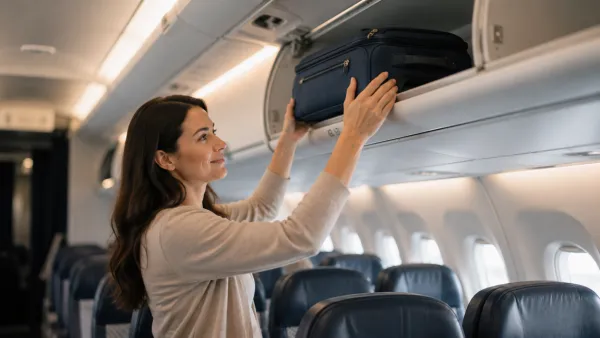
The basic rule is clear: important medications always belong in your carry-on bag, not in your checked luggage. A suitcase can be delayed, lost, or end up at the wrong airport. Any medicine you take regularly or may need quickly must be with you in the cabin.
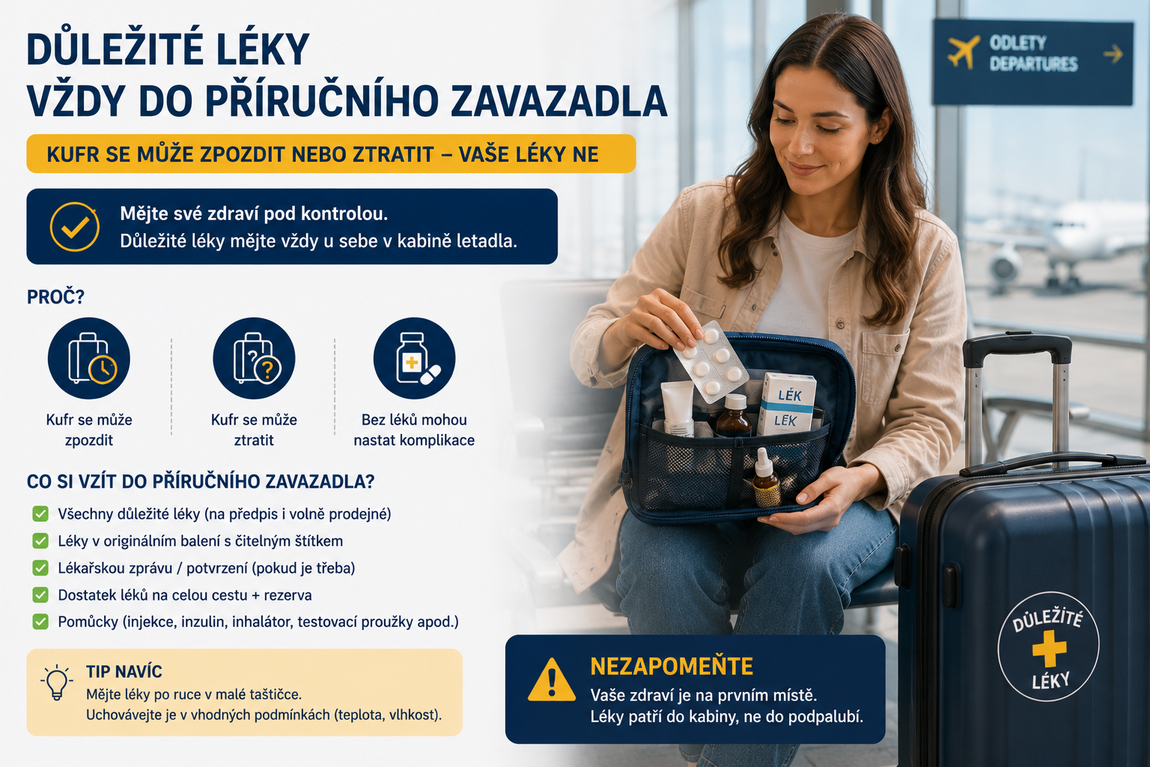
At the airport security checkpoint, present your medications to the officer separately, especially if they are liquids over 100 ml or injections. A proactive approach speeds up the whole process. Security staff are used to medical items, but they expect you to explain the situation yourself. If medicines do not pass through the automatic scanner without issue, they will be checked individually.
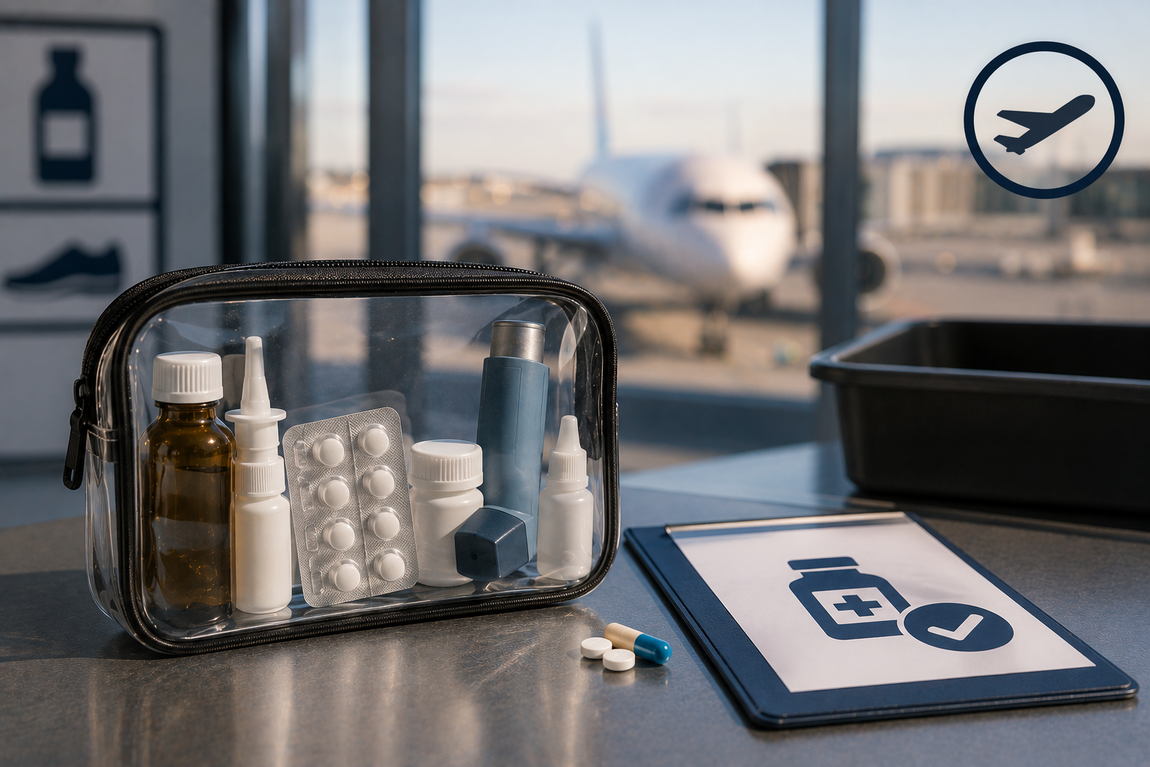
Ideally keep your medications in their original packaging with the patient information leaflet. Pills decanted into a plastic bag raise questions; the original packaging is self-explanatory and speeds up clearance.
Medications in your checked luggage
Common over-the-counter products such as vitamins, painkillers, or plasters travel fine in a checked bag. For medicines you are actively taking, however, that is not the ideal choice.
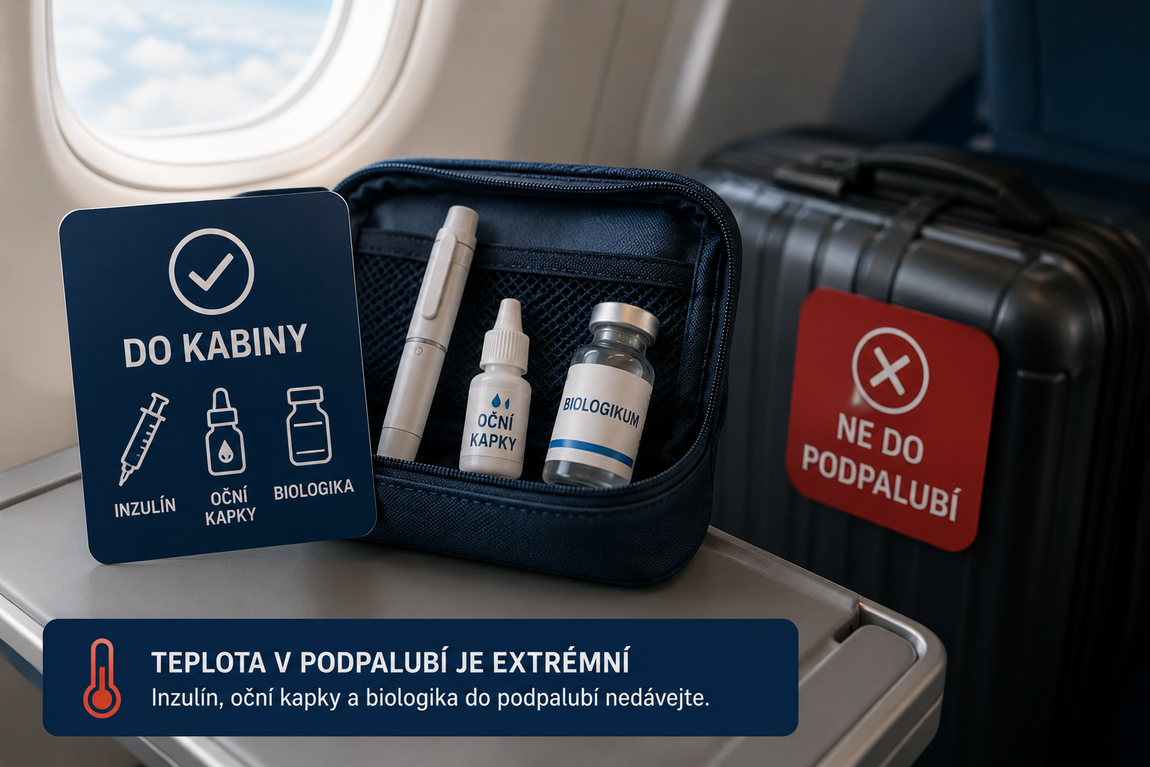
The aircraft hold overheats in summer and cools dramatically in winter. Temperature-sensitive medicines (insulin, eye drops, certain biologics) can lose their effectiveness or be rendered completely useless. If you have only one supply of a medication with no way to get a replacement abroad, it is not worth risking its loss or damage in the hold.
It is perfectly fine to pack backup supplies of over-the-counter products in your suitcase, or a larger quantity that does not fit in your carry-on. For key medications, always split the supply: some in your hand bag, some in the suitcase as a backup.
And before you start thinking about what to take on the plane, decide where your car will spend the whole holiday. Check out the benefits of parking near the airport and choose a monitored car park with a direct transfer to the terminal.
Compare any airport car parks side by side - prices, distances, ratings. No jumping between websites; find the best option for you here and book in under a minute.
How to pack medications for a flight
Tablets and capsules
Solid dosage forms have no quantity restrictions provided they are for personal use. Carry them in their original packaging with the patient information leaflet. Security officers and customs officials abroad can see immediately what you are carrying and what it is for. Pills decanted into a tub or bag are not technically prohibited, but they may cause delays and questions.
Liquid medications
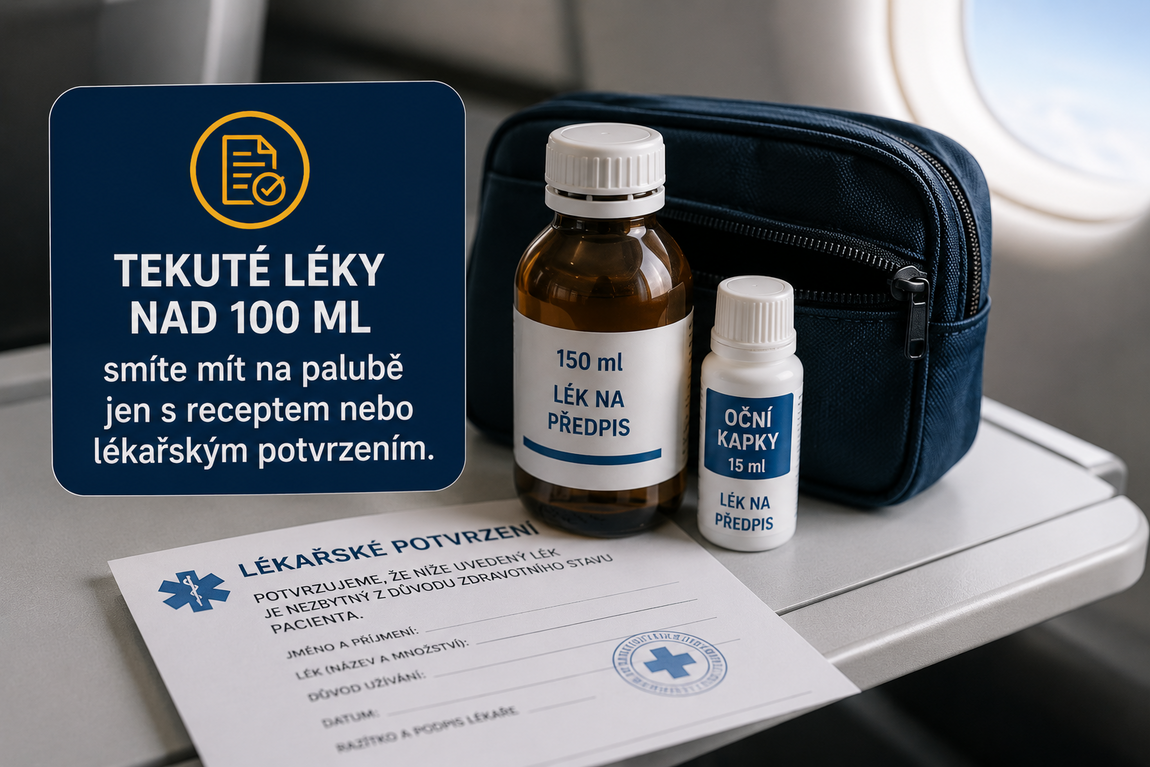
Liquid medications are subject to the standard 100 ml rule unless they are required for your medical condition. Medicines essential for your health - syrups, drops, injections, insulin - may be carried on board in the quantity you need even beyond this limit, but always with a doctor's note or prescription. Take this category of medication out of your bag before entering the screening lane and present it together with your documentation.
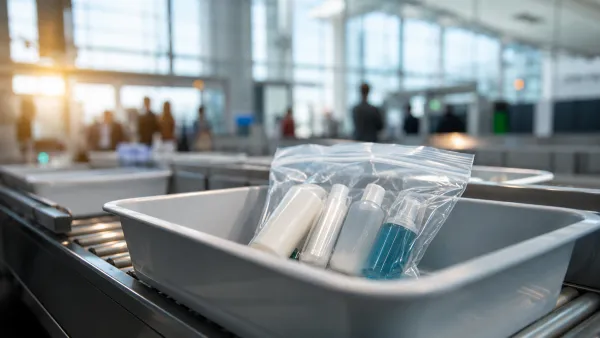
Liquid medications that do not exceed 100 ml and are not part of your daily regime should be packed in a clear resealable bag together with your other liquids. The rules for liquids on a plane apply here too.
What to keep within easy reach
Emergency medications (EpiPen, nitroglycerine, inhaler, and similar) should be in your personal bag or pocket, not at the bottom of a suitcase. The same applies to insulin and a diabetic's blood glucose meter. When nausea or an allergic reaction strikes on board, seconds matter.
Which medications can I take on a plane without a prescription?
Over-the-counter medicines and a basic travel first-aid kit require no special documentation. Pack the following without worry:
- pain relievers and fever reducers (ibuprofen, paracetamol, aspirin)
- anti-diarrhoea and anti-nausea preparations
- motion sickness tablets
- antihistamines for allergy sufferers
- nasal sprays and eye drops
- contact lens solutions
- antiseptic, plasters and bandages
- sunscreen and insect repellent
- electrolyte supplements
- and glucose drinks for diabetics.
Everything in its original packaging; liquids in the standard clear resealable bag.
Before you board, we recommend reading the guide on how the airport works, which walks you through the entire process from arrival to boarding. The overview of what airport check-in involves is also helpful if you are a first-time flyer.
Sort out parking before you start packing too. An overview of the cheapest options is available on the cheap Prague Airport parking page.
Some people want the cheapest car park, others the one closest to the terminal, and others the highest-rated. Our comparison tool shows all options at once - just pick the one that suits you. Book instantly, cancel any time up to 24 hours before arrival.
When you need a prescription or doctor's note
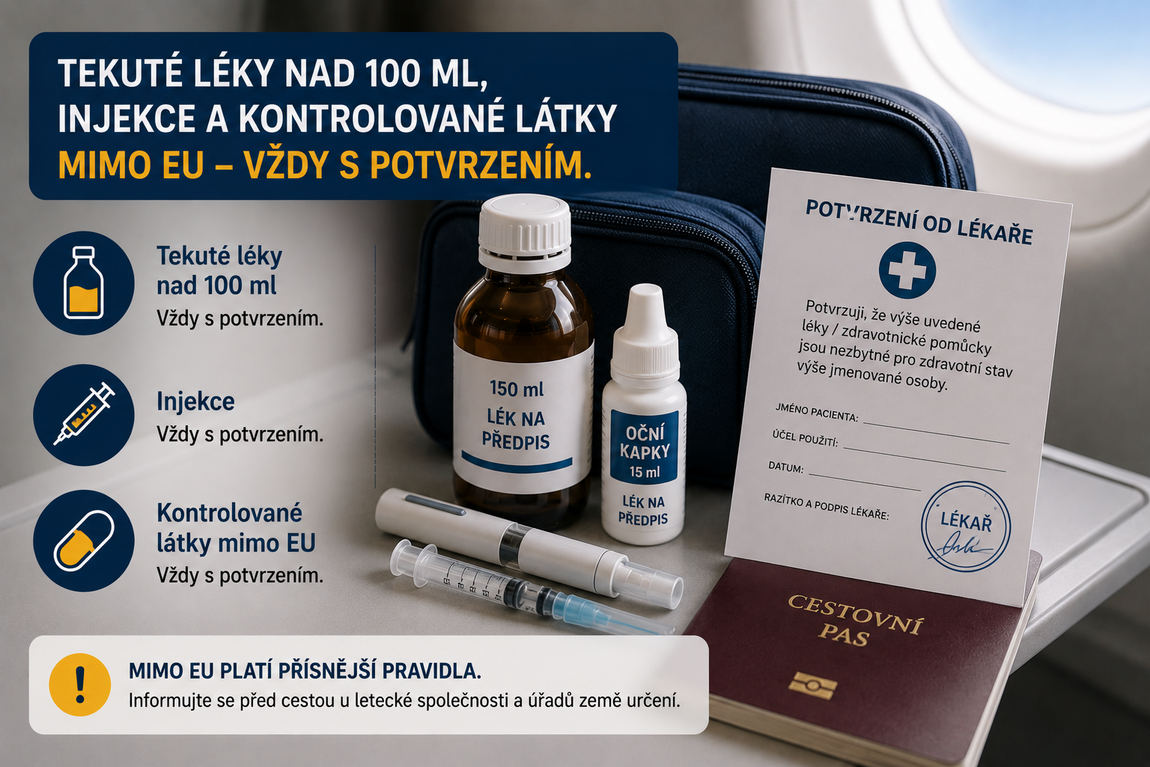
A prescription or doctor's note is required in three situations: you are carrying liquid medications over 100 ml, you are carrying injections or other medical devices (syringes, blood glucose meters), or you are travelling outside the EU with medicines that fall under the category of controlled substances.
The note should include your name, the name of the medicine, the dosage, the purpose of use, and ideally be written in English or the language of the destination country. When travelling to countries outside the EU - Turkey, Egypt, Thailand, the USA - do not underestimate the importance of this documentation. Rules differ from country to country, and something freely available over the counter in your home country may be on a list of controlled substances elsewhere.
Medications and medical devices requiring documentation
- Prescription drugs - antidepressants, sedatives, opioid painkillers and other psychoactive substances are strictly regulated in most countries. Without a doctor's note you risk having them confiscated at customs, or worse.
- Insulin and diabetic supplies - insulin is temperature-sensitive and belongs in your carry-on; you may carry the syringes for it without any issue provided you have documentation.
- EpiPen and adrenaline injections - permitted on board, but a note from an allergist confirming you need them available is required.
- Inhalers - generally permitted; for less common preparations we recommend carrying the prescription.
- Respiratory devices and specialised medical equipment - a portable oxygen concentrator or CPAP machine must be notified to the airline at least 48 hours before departure. Each carrier has its own approval procedure for such devices.
Security screening with medications - step by step
Before entering the screening lane, take your medications out of your bag and have them ready in your hand. Separate liquid preparations and medical devices. Attach your documentation to them.
Let the security officer know that you have liquid medicines above the standard limit or medical devices. There is nothing to hide and no need to apologise - this is a routine situation that officers deal with every day. Medical devices such as blood glucose meters, inhalers or syringes go through individual screening, which takes a minute or two.
After passing through, put everything back in your bag, check that your medications are still within easy reach, and watch the display for your gate.
The most common mistakes when travelling with medications
- Missing documentation for liquid medicines or injections is the most common cause of delays. Security staff cannot allow medicines over 100 ml through without sufficient proof of medical necessity.
- Carrying medications without their original packaging makes identification harder and can raise suspicions of illegal substance transport abroad. The original box is enough - it does not need to be a full, unopened pack.
- Putting all medications in checked luggage is a risk that is simply not worth taking. Luggage is lost at a rate of roughly 7 per 1,000 checked bags; for passengers with chronic conditions this is a very real problem.
- Not knowing the rules of the destination country catches travellers off guard especially in Japan, Greece, or Gulf states, where some freely available medicines appear on lists of prohibited or strictly controlled substances. Always verify current rules on the embassy or customs authority website of your destination.
A well-stocked travel kit is the foundation of a smooth holiday
Taking medications on a plane is no problem at all - you just need to know what goes where. Tablets loose in your bag, liquid medicines in a resealable bag or with a note, prescription drugs and injections with a doctor's documentation. Always original packaging, and always keep what you cannot do without in your carry-on.
Also check the carry-on luggage size limits for your airline and make sure you know what to expect at the airport security checkpoint.
Leave your car in safe hands before departure - an overview of verified monitored car parks near Prague Airport is available in our article on Prague parking comparison. Choose by distance, price or rating and reserve your spot from home. The sooner the better - popular car parks fill up fast in peak season.
Cheapest, closest or highest-rated - the choice is yours. Our comparison tool shows all available airport car parks at once, with no hidden fees and without having to trust the first Google result.