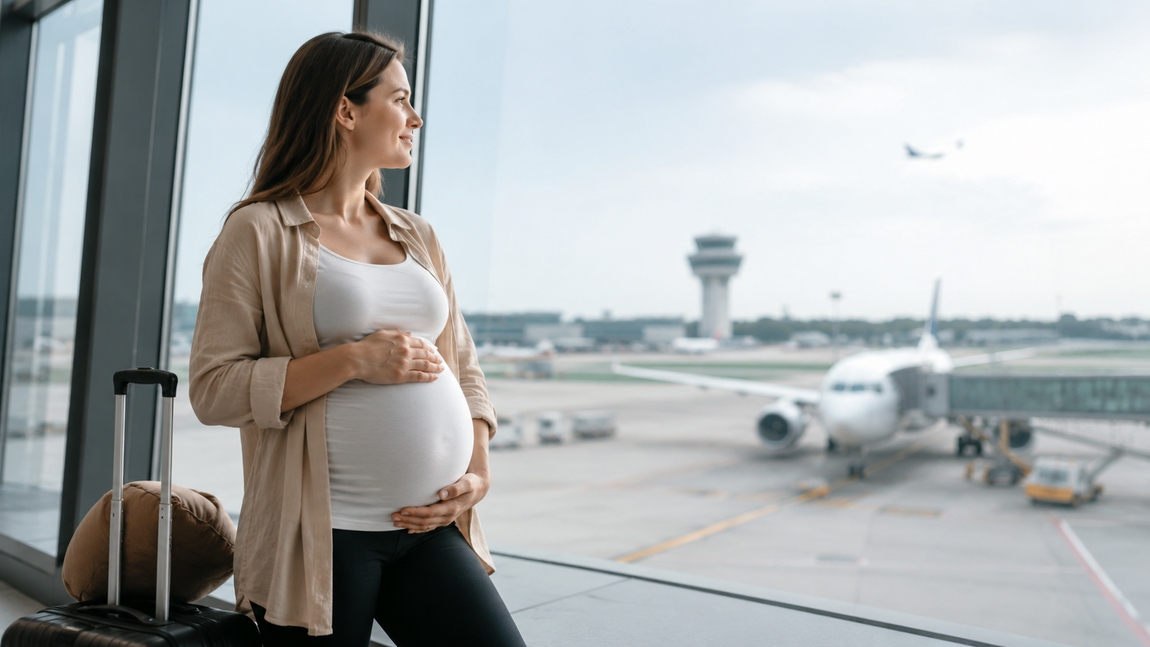
Planning a trip by air and sorting out the logistics? Make sure your airport drop-off is stress-free by arranging parking in advance. Compare, choose and book from a selection of available airport car parks - all in one place, in just a few clicks.
What are the risks of flying during pregnancy?
Flying itself is not dangerous for a pregnant woman. Nevertheless, there are a few things worth keeping in mind.
Cabin pressure and oxygen levels
Cruising altitude corresponds to a pressure equivalent to roughly 2,000 metres above sea level. The oxygen level in the cabin is slightly lower than on the ground, but a healthy body and placenta handle this without any problem. For women with anaemia or cardiac complications it may put more strain on the body, so it is best to consult your doctor beforehand.
Risk of thrombosis
Pregnancy already increases blood-clotting tendency on its own. Combined with prolonged sitting on a flight, the risk of thromboembolism multiplies further. Every 30 minutes, stand up and stretch your legs, do ankle exercises, walk the aisle. Compression socks are practically essential for flights longer than two hours.

Cosmic radiation
A single flight exposes passengers to a minimal dose of cosmic radiation that is safe for the foetus. The risk would theoretically accumulate only with very frequent flying - think dozens of hours per month. For an ordinary holiday, this number is completely irrelevant.
Nausea, fatigue and dehydration
The aircraft environment is drier than outdoor air, and the nausea that pregnant women are prone to can feel more intense on board. Drink water regularly, avoid alcohol and carbonated drinks, and choose light meals.
When it is better to skip flying during pregnancy
For some pregnant women, a flight is simply not the right choice, regardless of trimester.
A doctor will recommend staying home in cases of high-risk pregnancy with bleeding or threatened miscarriage, placenta praevia, multiple pregnancy from a certain stage, and generally any unstable situation where being far from medical care could be problematic.
Airlines usually refuse to carry passengers past the 36th week of pregnancy. For multiple pregnancies this restriction applies from the 28th week onwards. Each airline has its own rules, so always verify the conditions directly with the carrier before purchasing a ticket.
The destination matters too. Exotic countries with poorer healthcare, endemic diseases, or required vaccinations (some vaccines cannot be given during pregnancy) can add further variables to the equation.
Before you travel, also check the rules for medications on a plane, especially if you take regular medication or carry injections.
Sort out your airport parking before the trip. Choose from monitored car parks with a direct transfer to the terminal, book instantly, and cancel up to 24 hours before your arrival.
Flying during pregnancy by trimester
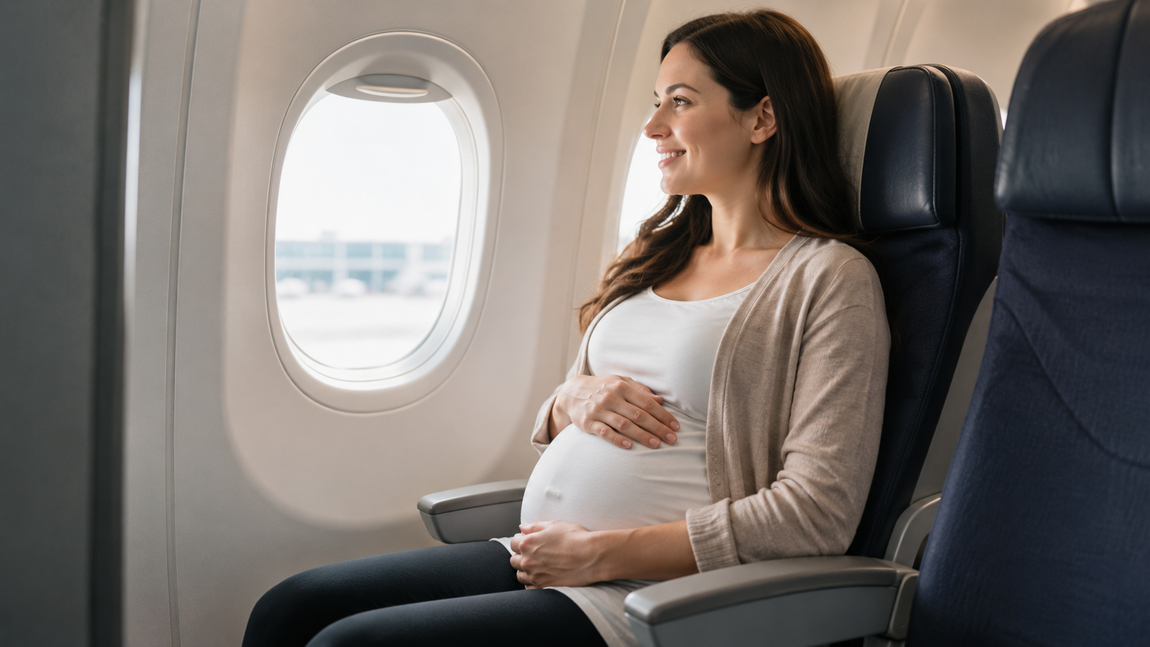
Risks of flying during pregnancy in the first trimester (weeks 1-12)
The first twelve weeks are the most sensitive period of pregnancy. Nausea and fatigue may be more intense on board than on the ground. The risk of miscarriage is naturally at its highest during this time, even though a flight itself is not usually the cause.
If the pregnancy is progressing without complications and your doctor has no objections, flying in the first trimester is possible. Many women are not even aware they are pregnant in the early weeks and travel without any restrictions. Even so, the rule stands: always consult your gynaecologist beforehand.
Flying in the second trimester (weeks 13-24)
The second trimester is generally the calmest and most comfortable period of the entire pregnancy. Nausea typically subsides, the risk of miscarriage drops significantly, and the body is stable. Most gynaecologists consider this the best time to travel by air.
Even when travelling in the second trimester, take your maternity notes with you and check before departure whether your travel insurance covers pregnancy-related medical complications.
Flying is not recommended in the third trimester (weeks 25-40)
As the bump grows, restrictions come from two directions. Airlines require a written fitness-to-fly certificate from a gynaecologist from approximately week 28 (for multiple pregnancies) or from week 32-36 (for a single pregnancy). After week 36, most carriers will not allow pregnant passengers on board at all.
Alongside the paperwork, physical discomfort increases - prolonged sitting in a narrow seat, restricted movement, and a higher risk of swelling and thrombosis. If the flight is not essential, it is not recommended in the third trimester.
Airline rules for pregnant passengers
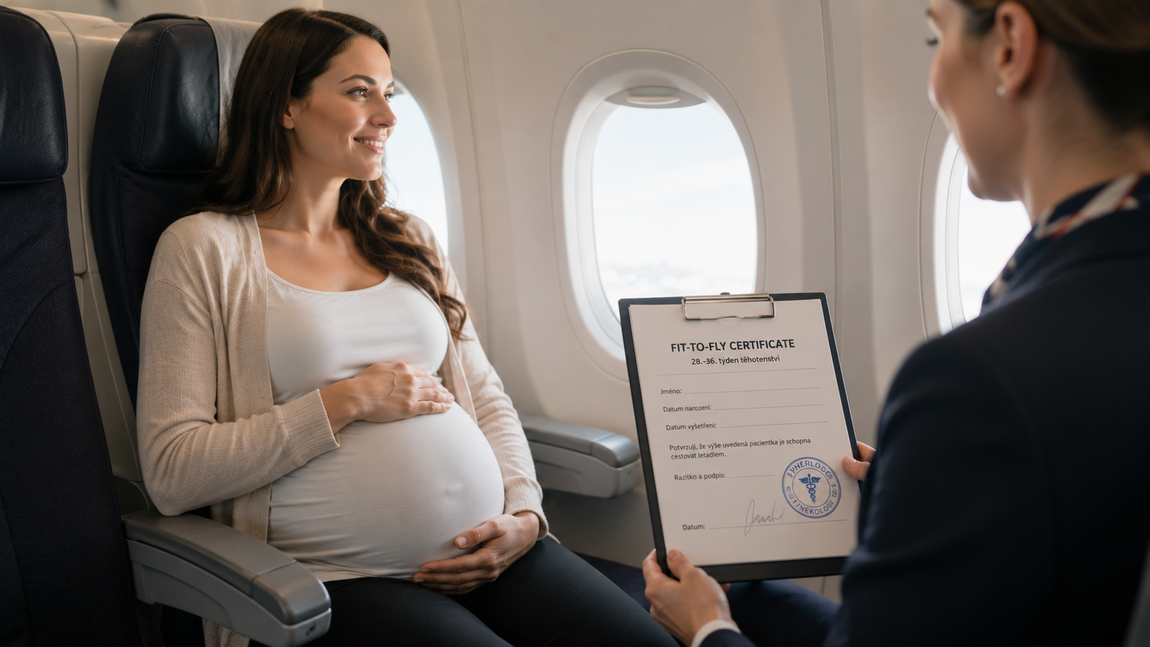
Every airline has its own policy for carrying pregnant passengers, and the details differ:
- Ryanair and Wizz Air generally do not require any documentation up to week 28; a fit-to-fly certificate is needed from week 28 to 36, and carriage is not permitted after week 36.
- easyJet applies similar rules.
- Smartwings recommends a consultation from week 32 onwards.
- Lufthansa and traditional full-service carriers tend to be more lenient and typically only require a fit-to-fly certificate from week 36.
Rules also vary with flight duration. Long intercontinental flights often have stricter conditions than short European routes. Always verify the current conditions directly on the airline's website rather than from secondary sources.
Security screening and pregnancy
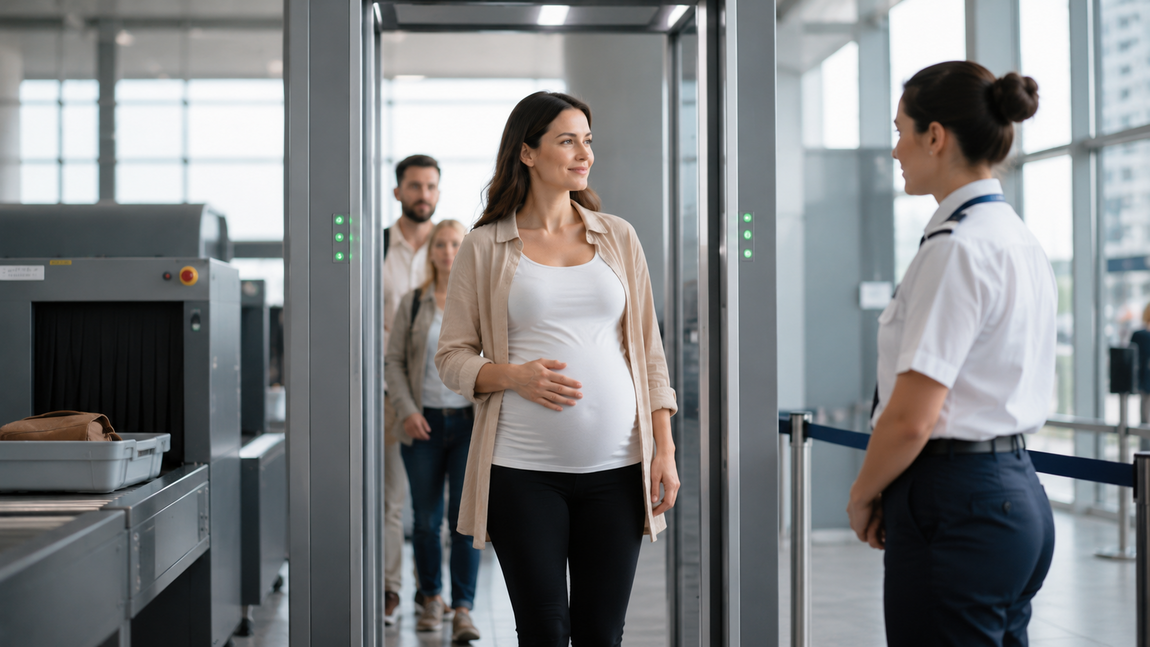
Going through security screening while pregnant should not cause concern. Metal detectors and full-body scanners at the airport do not use X-ray radiation. They rely on radio waves or millimetre waves, which have no effect on the foetus.
If you would still prefer not to go through a scanner, you have the right to request a manual pat-down. There is no need to justify your reason - security staff handle such requests as a matter of routine.
A full overview of the airport security screening process and a guide to airport check-in are available in separate articles - handy if you are flying for the first time or just want a refresher.
How to prepare for a flight during pregnancy
A consultation with your gynaecologist is essential even when you feel great and the pregnancy is progressing without complications. Your doctor will assess your specific health situation and either confirm or advise against travel.
Take out travel insurance that covers pregnancy-related complications. Standard policies do not include this cover automatically - it must be explicitly added or verified.
An aisle seat gives you freedom of movement. You can get up, stretch and visit the bathroom without climbing over fellow passengers.
The documents you cannot do without are your maternity notes, the fit-to-fly certificate from your doctor (if the airline requires it), your travel insurance policy and your standard travel documents. Check the carry-on luggage size limits for your airline in advance.
Practical tips for a comfortable flight during pregnancy

- Dress in loose, comfortable layers; synthetic fabrics in the dry cabin environment are a poor choice. Put on your compression socks before boarding, not once you are already on the plane.
- Drink regularly throughout the flight - plain water is best. Get up and walk at least once every 30 minutes, even if it means disturbing the people in your row. An aisle seat eliminates this problem entirely.
- Choose light meals. Bloating and digestive issues that often accompany pregnancy are made worse by the reduced cabin pressure. Large meals immediately before or during the flight will not help.
- If you suffer from nausea outside of flying too, keep a suitable remedy within reach - and check the rules for medications on a plane and carrying them in your hand luggage.
Flying and pregnancy - frequently asked questions
Is flying safe for the baby?
Yes - for a healthy, uncomplicated pregnancy, a one-off or occasional flight is safe. The foetus is well protected, and a short-term pressure change or slightly reduced oxygen level will not cause harm.
How far into pregnancy can you fly without airline restrictions?
Most airlines require no documentation up to week 28. Between weeks 28 and 36, a fit-to-fly certificate is typically required. After week 36, carriage is prohibited by almost all carriers.
Do you need a doctor's certificate?
It depends on the trimester and the airline. Up to week 28, generally not. From week 28 onwards, most carriers require one. The certificate is issued by a gynaecologist and is usually valid for only a few days from the date of issue.
What should you do if complications arise during the flight?
Call a flight attendant immediately. Crew members are trained in basic first aid, and large aircraft on long-haul routes carry medical equipment on board. In a serious situation, the pilot can divert and land at the nearest airport.
Pregnancy does not have to mean the end of travelling
A healthy, uncomplicated pregnancy is not a barrier to flying - especially in the second trimester, which is by far the best time to travel. Pay extra attention during the first and third trimesters and always consult your doctor.
Prepare in advance: the medical certificate (if required), insurance, the fit-to-fly certificate, and compression socks. The same applies to getting to the airport. The less stress before departure, the better - for you and for the baby.
Our guide to the benefits of parking near the airport explains why a monitored car park with a transfer service is a particularly good idea when you need to keep as many things off your mind as possible. If this is your first flight, our guide for first-time flyers will also come in handy.
Choose an airport car park through our comparison tool, secure your spot, and head to the airport without unnecessary hassle. Enjoy your holiday knowing your car is in safe hands.