A relaxed flight usually starts with sorting out decent parking for your car in good time. You can book a space at the airport in advance through our comparison tool. Compare the secure car parks on offer, with a shuttle straight to the terminal, and give yourself one less thing to worry about.
At what age can a baby fly on a plane?
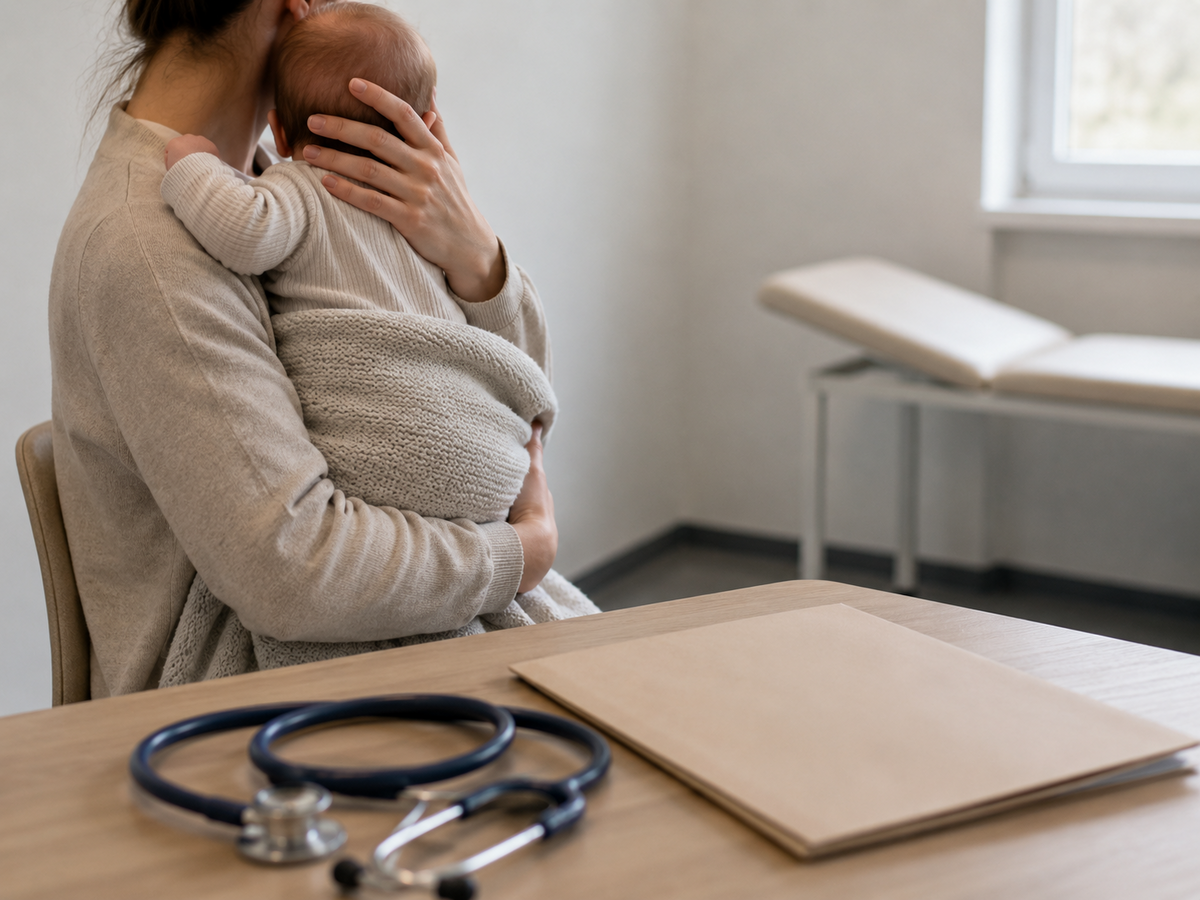
Most airlines accept babies from two weeks of age. Even so, we recommend talking to your pediatrician before a newborn's first flight. The doctor will assess the baby's health and tell you whether flying is suitable, or when it will be. The cabin has lower air pressure and drier air than the baby is used to, and that environment does not suit every infant.
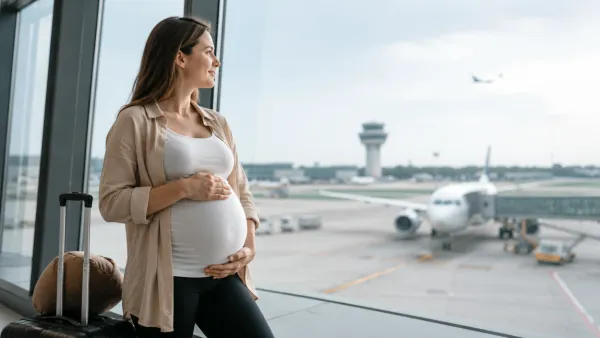
And if your baby is still on the way, read our guide to flying during pregnancy, which sets out all the rules that apply before the birth.
The ticket and the seat for your baby
Depending on the airline, children under two sometimes fly free of charge and sometimes for far less than an adult fare. Real-world prices look something like this:
| Airline | One-way fare (child under 2) |
|---|---|
| Ryanair | EUR 25 / approx. CZK 620 |
| Wizz Air | EUR 31 / approx. CZK 760 |
| easyJet | GBP 25 / approx. CZK 730 |
| Smartwings | CZK 386–500 |
| Eurowings | EUR 25 / approx. CZK 610 |
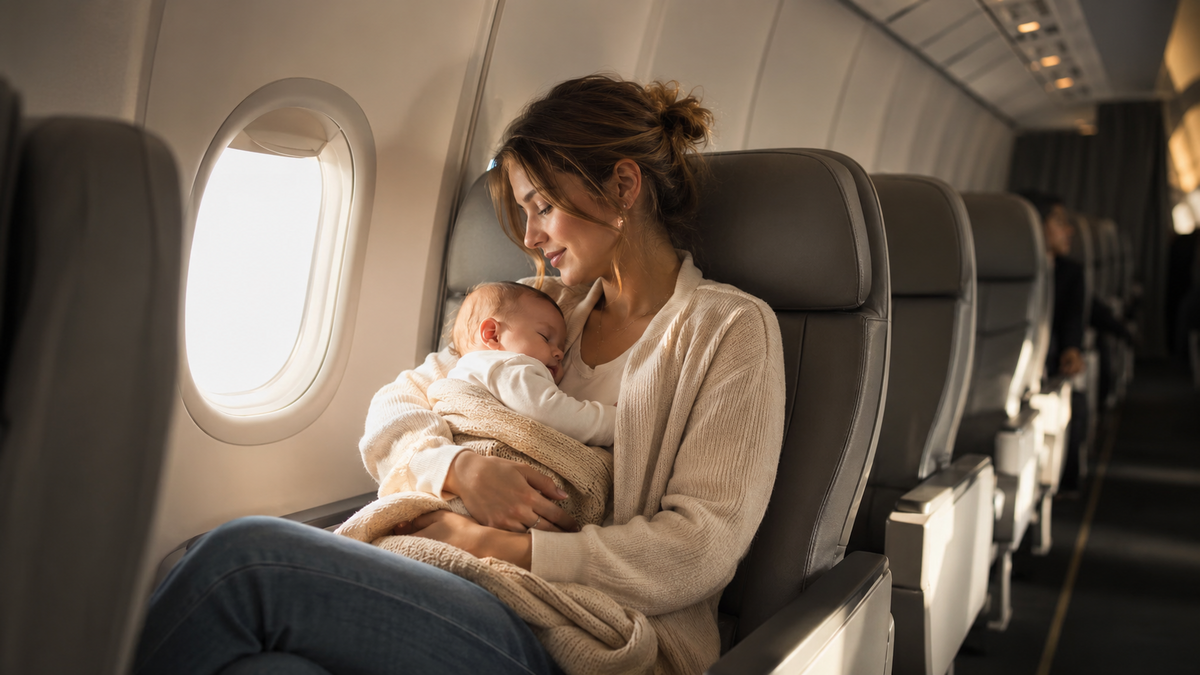
A baby under two does not get a seat of its own and travels on an adult's lap for the whole flight. For takeoff and landing the crew will hand you an infant extension belt that loops onto your own seat belt.
Your baby can of course have a seat of its own with a car seat fitted in it, which is more comfortable but more expensive: sometimes you pay the full adult fare, sometimes the airline gives you a child discount.
Once a child turns two, it pays the full fare. At Ryanair, children under 12 can take two pieces of baby equipment free of charge plus a cabin bag, just like an adult. At Wizz Air the same benefits run up to the age of 14.
Travel documents for the flight
Within the Schengen area, a valid ID card in the baby's own name is enough. Even newborns need their own proof of identity; a child cannot simply be entered in a parent's document.
For flights outside Schengen (the UK, Turkey, Egypt, the USA) your baby needs a valid passport of its own. You apply for a child's passport at your municipal authority, and it is valid for five years.
If you are traveling without the other parent, some destinations ask for the absent parent's notarized consent to the trip. Check what your destination country requires in advance, especially outside the EU.
Before you set off, it is also worth reading our overview of how things work at the airport, which walks you through the whole process step by step, from arrival to boarding.
With a stroller, a car seat and a diaper bag to handle, a smooth arrival at the airport is worth a lot. Book a secure car park through our comparison tool and you get a shuttle straight to the terminal and a pick-up when you fly back.
Baggage and the stroller when flying with a baby
Every baby under two gets a free baby baggage allowance on top of the adults' luggage. The rules vary from airline to airline:
| Airline | Free baggage for the infant | Free baby equipment |
|---|---|---|
| Ryanair | 1 bag up to 5 kg (45 × 35 × 20 cm) | 2 items (stroller, car seat, travel cot) |
| Wizz Air | 1 bag (40 × 30 × 20 cm) | stroller OR travel cot |
| easyJet | 1 diaper bag (45 × 36 × 20 cm) | 2 items |
| Smartwings | no allowance | stroller, travel cot, car seat |
| Eurowings | 1 bag (40 × 30 × 25 cm) | 2 items |
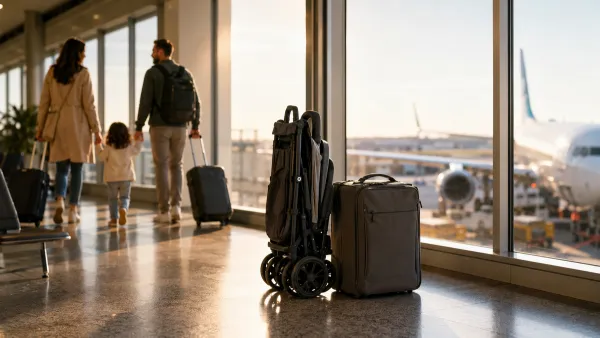
You can always take a stroller with you, including a full-size pram with a carrycot. You hand it over at the check-in desk or later at the gate, where the ground crew load it into the hold. After landing you get it back either right at the aircraft or on the baggage carousel with everything else. We look at this in more detail in our guide to packing a stroller for a flight.
At Ryanair, a framed baby carrier or a sling counts as one piece of baby equipment in place of the stroller. It is a practical alternative: it keeps you mobile around the airport and makes security a good deal easier.
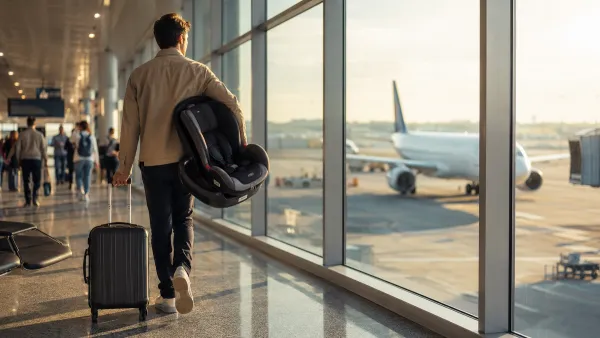
A car seat travels free of charge as baby equipment. If it carries TÜV aviation certification and has a 5-point harness, you can also take it into the cabin and strap your baby in safely. Our guide to car seats on a plane explains all the certification rules.
Packing tip: before you leave, put together a vacation packing list just for the baby – diapers, spare clothes, a changing pad and travel medicines. Leave nothing to chance.
How to fly with a baby – the preparation
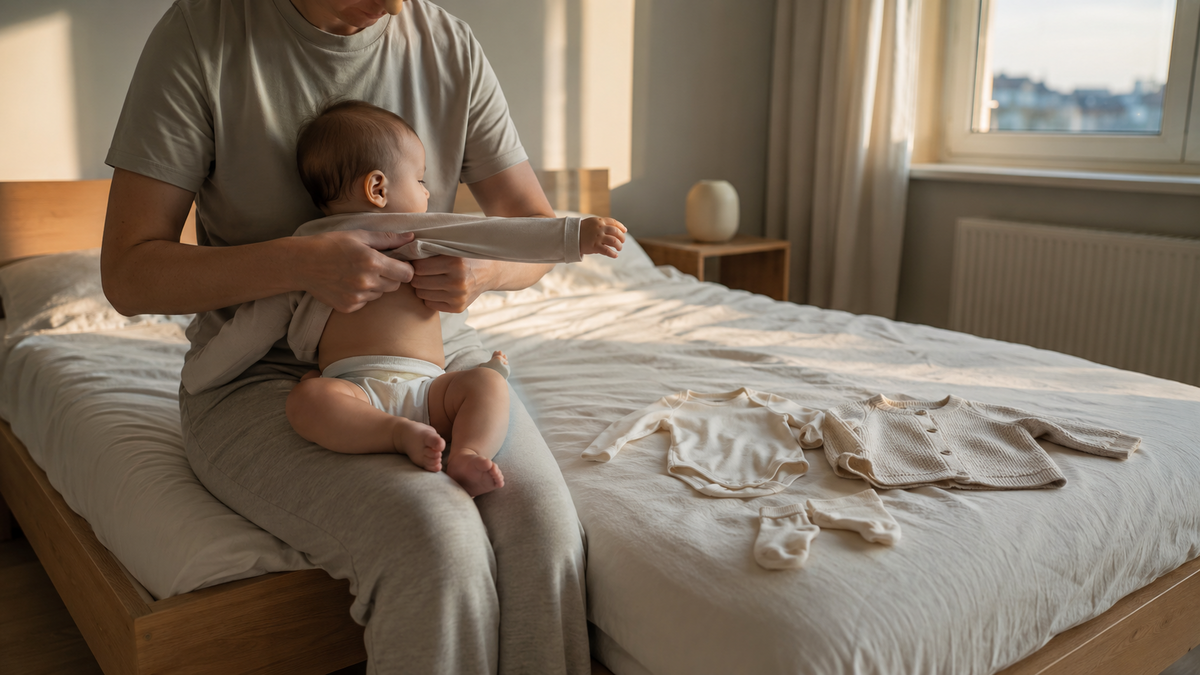
- The departure time matters more than you might think. A night flight works well for babies who sleep through, but exhausted parents cope with it far less well. For most families an afternoon flight, with a baby rested after its nap, is the calmer option.
- Dress the baby in layers. The cabin temperature can change, so layers come in handy. Pack a light blanket in case it gets cold.
- Travel insurance that covers your child's medical care is a must. Check that the policy applies to babies and how emergency treatment is handled in your destination country.
- Get to the airport at least 30 minutes earlier than the standard recommendation. With a stroller, a diaper bag and an infant in tow, every step takes longer.
Your baby on board: feeding, diaper changes and ear pressure
Feeding
Breastfeeding on board is allowed without restriction. If you use formula, you can take a thermos of water into the cabin. Cabin crew will usually not hand out hot water for making up a bottle, for hygiene reasons – the water tanks tend to sit close to the lavatory system. Ready-made liquid formula in small packs, or portions measured out in advance, is the more reliable option.
At Prague Terminal 2, past security, the rules on baby liquids are more relaxed: you may take containers of up to 200 ml on board for your child, above the standard limit, as long as you declare them as baby food.
Diaper changes
You will find a changing table in the restrooms at the airport and on board most larger aircraft. Short low-cost flights have no changing table on board, so pack a foldable changing pad and change the baby on your seat or on the floor by the lavatory.
Ear pressure
Cabin pressure changes during takeoff and landing, and a baby feels it just as an adult does. Sucking at the breast or on a bottle equalizes the pressure in the middle ear naturally. That is why a feed timed for takeoff helps most of all.
A bassinet on board
On longer flights, usually over 4–5 hours, full-service carriers let you request a bassinet in advance: it clips onto the bulkhead at the front of the cabin section. There are only a few of them, so ask as soon as you have bought your ticket. The baby has to fit into the bassinet and lie in it without its movement being restricted, and the weight limit is usually around 11 kg.
Airport perks and facilities for parents with a baby
At most larger airports, families with small children get priority at the check-in desk and priority boarding. Wizz Air states explicitly that families with a child under two are given priority both at check-in and at the gate. Up to two accompanying adults can use it.
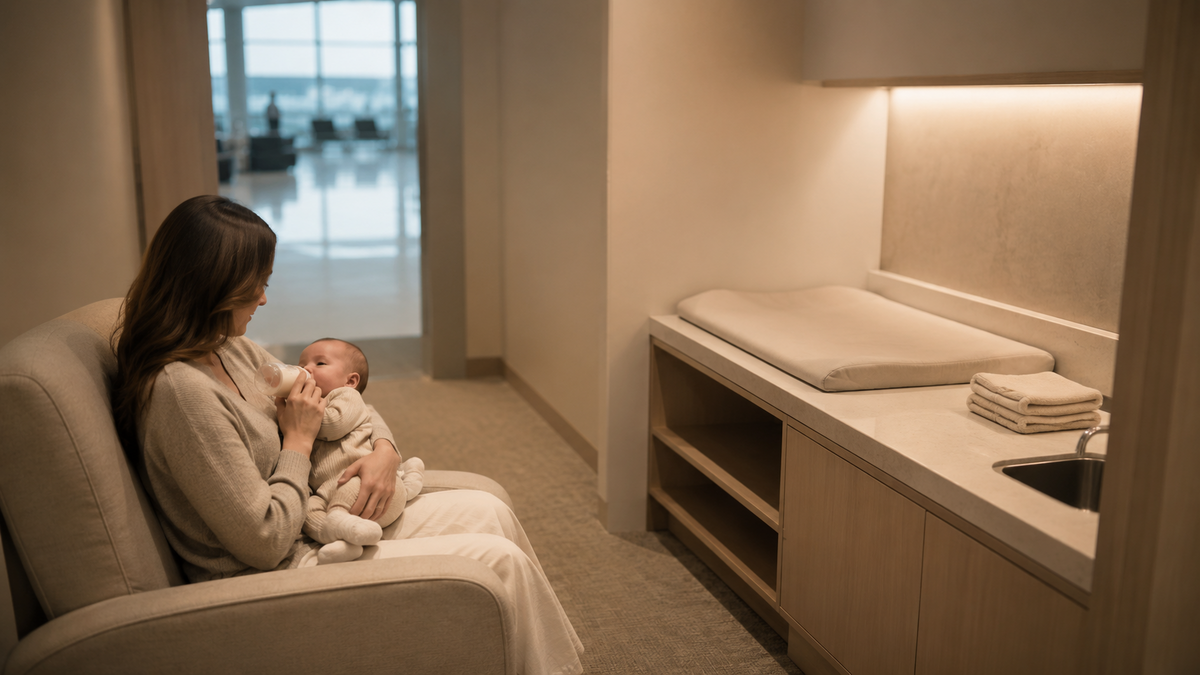
Past security in Terminal 2 at Prague Airport there is a baby room with a changing table, a microwave, a nursing armchair and a quiet corner to feed in. Strollers to borrow are parked past security like shopping carts, and you leave them at the gate once you are done.
Other European airports have children's areas too, of course. Vienna has an excellent play area by gate F1, for instance, and Alicante a baby room right by the gates. If you are flying from an airport you do not know, study the terminal map beforehand.
With a stroller, a bag and a baby in your arms, every extra walk is one too many. A shuttle from a secure car park drops you right at the terminal. Use our comparison tool and find parking with a shuttle at the best price before you fly.
What to do when your baby cries on the plane
A crying baby on a plane usually bothers the parents far more than the people sitting around them. The crew and the other passengers have seen it all before – everyone was a baby once, and a plane is a public space.
The most common reasons for crying are hunger, a full diaper, overheating or simply too many new impressions. So run through it in your head: when was the baby last fed, last changed, and how long has it been awake? A feed timed to takeoff and landing deals with hunger and ear pressure in one go.
If the baby cries and you cannot work out why, get up and walk it down the aisle. Movement is soothing. Pack a couple of favorite toys or a rattle to catch its attention and settle it.
Being considerate towards the people around you comes naturally, but the essential thing is not to lose your own calm. Tired, stressed parents pass their tension straight on to the baby. Breathe deeply, take turns with your partner and do not be afraid to ask the crew for help or advice.
A short packing list for flying with a baby
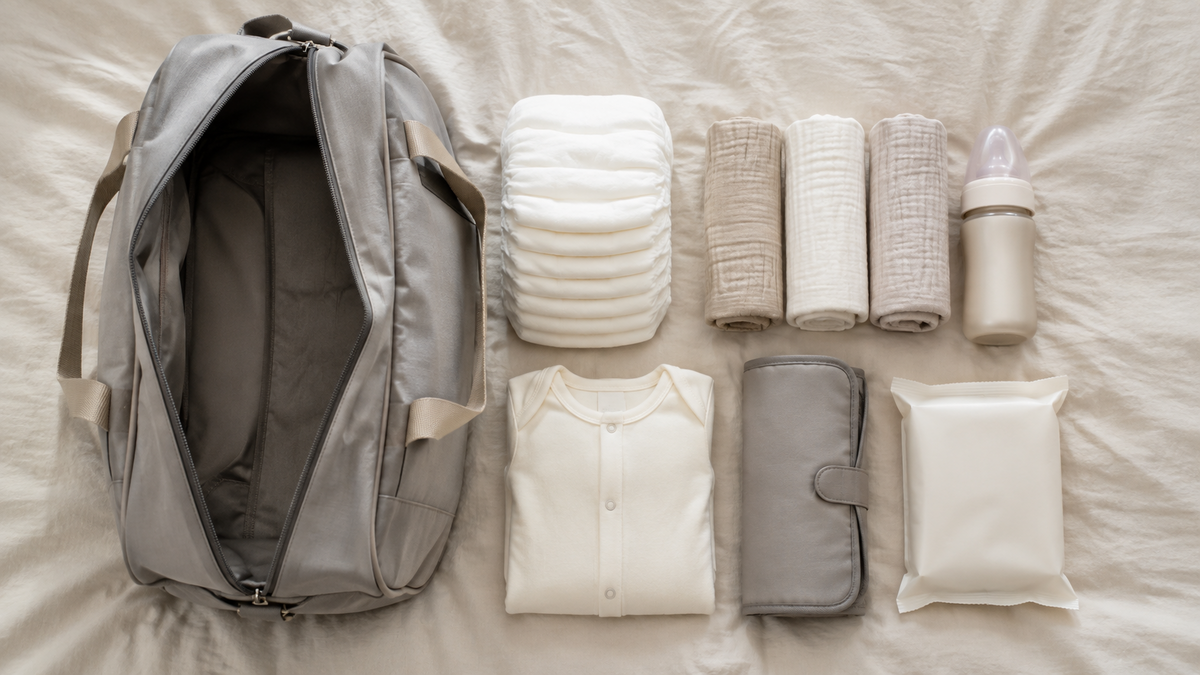
Before you close the suitcase, run through the things you cannot manage without on board:
- For changing: diapers with plenty to spare (more than you think), wet wipes, a foldable changing pad, spare clothes for the baby and for yourself (an infant can catch you out at any moment).
- For feeding: nursing mothers need nothing special; for formula, ready-made liquid packs or pre-measured scoops in a dispenser. A pacifier, if your baby takes one.
- For comfort: a light blanket, a sling or carrier to settle the baby, two or three favorite toys or a rattle. Headphones and a playlist or a podcast for the parents while the baby sleeps.
- In the cabin: everything above in your carry-on or diaper bag, not in checked luggage. Keep the boarding passes, the baby's documents and your own in the easiest pocket to reach.
- Go through a fuller vacation packing list for the baby again before every trip – what you need changes with the child's age and the length of the flight.
Any prepared parent can handle a flight with a baby
Flying with a baby does take some preparation, but in the end it causes no real trouble at all. What matters most: the right ticket, valid documents, the stroller handed over at the gate, the diaper bag within reach and a feed timed for takeoff or landing. The rest falls into place easily, and your baby gets to log its first flight.
One thing you should sort out in good time before you leave, though, is parking. Take a look at our airport parking comparison and at how a parking reservation works, or read up on parking at Prague Airport. Then head straight into our comparison tool and pick the option that suits you best!
Save yourself the time, the nerves and the money that hunting for a free space on the day of departure costs you. Our comparison tool puts every available car park, its price and reviews from real travelers in one place. Pick one, confirm the booking and set off for the airport with one worry less!