Traveling with children means preparing on several fronts at once. The easiest one to tick off is airport parking – use our comparison tool to compare available guarded parking with a transfer straight to the terminal, book instantly and pay on site.
Travel car seats designed for flying
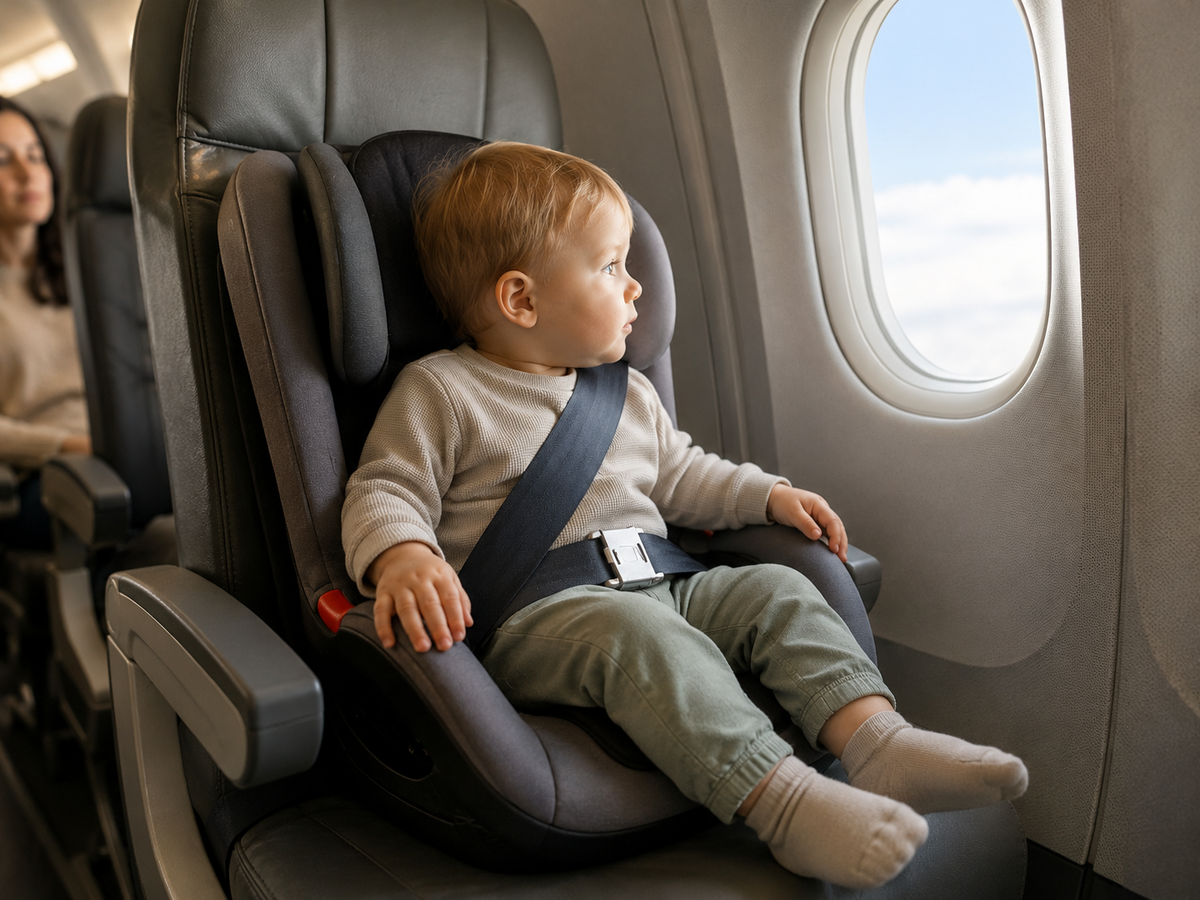
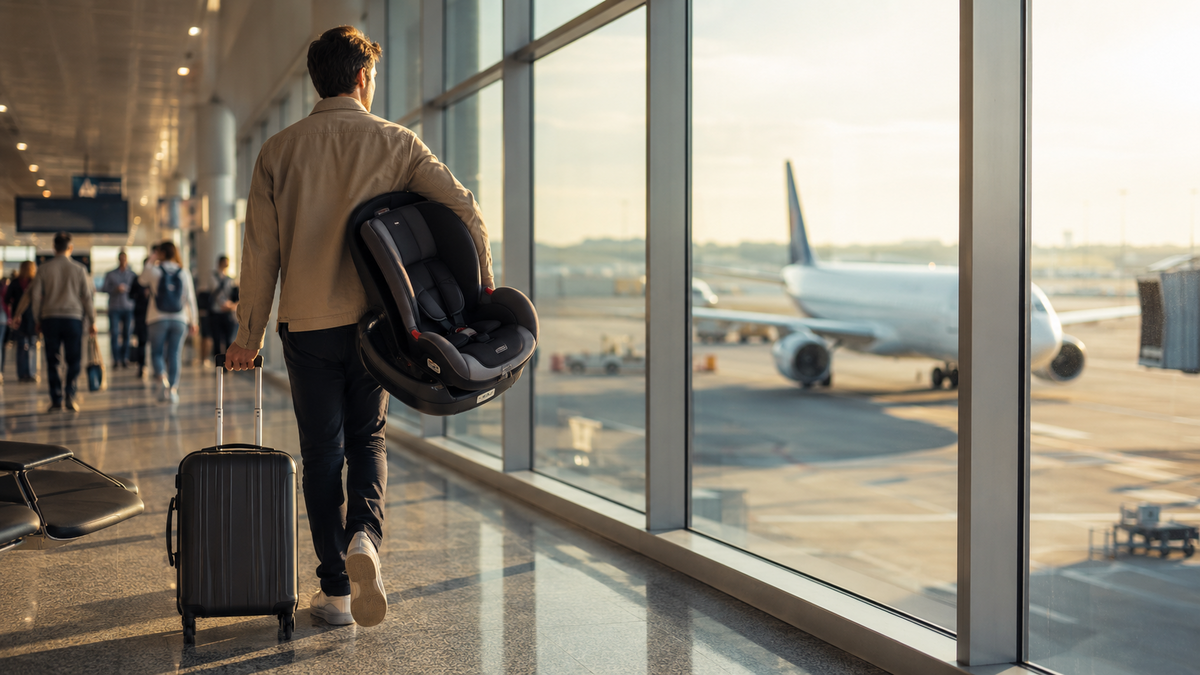
A traditional car seat weighs 5–12 kg, and at the airport you end up hauling it through check-in, to the gate, into the hold and back out at baggage claim. That's why lightweight travel models designed specifically for the plane + car combination have become the go-to choice for frequent travelers.
Compact folding seats such as the Cosco Scenera Next, Wayb Pico or Diono Radian fold into an included bag or pouch and weigh 3–5 kg. They're easier to carry, less prone to damage during loading, and will even fit in the overhead bin if the airline lets you bring the seat on board.
Rear-facing travel is safer for children up to roughly age 4 or 105 cm in height – it's recommended by leading authorities including the WHO and the European standard ECE R129 (i-Size). If the airline allows it and the seat is certified, a rear-facing seat can be used on board too, though only in selected seats (not next to an emergency exit).
Aircraft-certified car seats
Want your child to sit in their own car seat during the flight? The seat must be certified for aircraft use. What matters is the TÜV "For Use in Aircraft" mark or the equivalent FAA (Federal Aviation Administration) approval for flights to the USA.
The TÜV Rheinland "For Use in Aircraft" certification confirms that the seat meets aviation safety requirements and is recognized across Europe. The seat must have a 5-point harness, which most airlines insist on.
Certified models include the Cybex Sirona, Britax Römer KIDFIX, Maxi-Cosi Pearl, BeSafe iZi Go Modular and Recaro Avan/Monza. Always check the current list with your specific airline, though – the carrier always has the final say.
Using a seat on board means buying the child their own seat. For infants under 2, who would otherwise fly on a parent's lap at a reduced fare, bringing the car seat on board means paying for a full-price ticket. Children over 2 must have their own ticket anyway, so it comes down purely to certification and the airline's approval.
It's also worth reading up on what to expect from your first flight and the rules for checked baggage, especially if the seat is going into the hold as an extra piece of luggage.
And find out how early to be at the airport before departure when traveling with a child and a car seat. With kids, allow at least an extra twenty minutes on top of the standard recommendation.
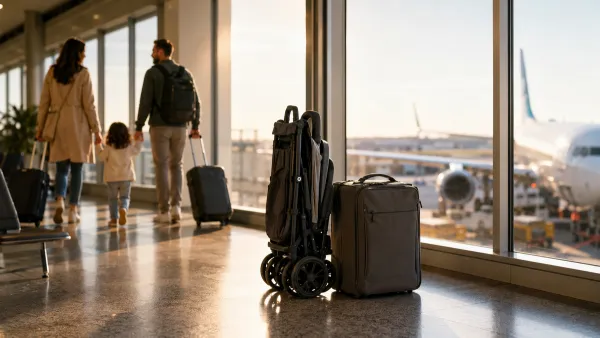
Of all your trip preparations, guarded airport parking with a transfer straight to the terminal is the quickest to sort out – just use our comparison tool. The shuttle drops you off right at the arrivals hall, making the trek with a stroller, car seat and luggage much easier. Get this part out of the way and free up time for everything else.
Booster seat rules for flying – Ryanair, Smartwings, Wizz Air
A booster seat is a lighter, more compact alternative to a full car seat, suitable for children from roughly age 3–4. It's far easier to manage both at the airport and on the plane.
Ryanair
Ryanair allows 2 pieces of children's equipment per child free of charge as so-called baby items. A stroller, car seat, travel cot or booster seat all count toward this total, so a booster flies free as one of the two items. The condition is that it goes through free as a baby item, not as standard baggage.
A seat taken on board must be forward-facing, certified for aircraft use and no wider than 17 inches (about 43 cm).
Wizz Air
Wizz Air lets you transport a car seat or travel cot free of charge as one piece of baby equipment, and a booster seat can travel as part of it. Always confirm the booster policy directly with the airline, though – staff interpret the rules differently at times.
Smartwings
Smartwings files car seats under sports and ancillary equipment. Transport is either paid or free depending on the fare and the specific flight, so always check the current conditions on the Smartwings website or by phone. And never travel with a rented booster seat – if it gets damaged or you need to make a claim, you'll have no record of its condition at handover, and neither the airline nor the rental company will compensate you.
Airline rules table
| Airline | Car seat free | Booster as baby item | Certification required | Note |
|---|---|---|---|---|
| Ryanair | yes (1 of 2 baby items) | yes | yes (TÜV/FAA) | max. width 43 cm, forward-facing |
| Wizz Air | yes (1 baby item) | yes (unofficially) | recommended | check with the airline |
| Smartwings | for a fee / by fare | per fare conditions | recommended | check in advance by phone |
| easyJet | yes (1 baby item) | yes | recommended | check online |
| Lufthansa | yes | yes | yes | applies to children under 2 with their own ticket |
How to pack a booster seat for a flight
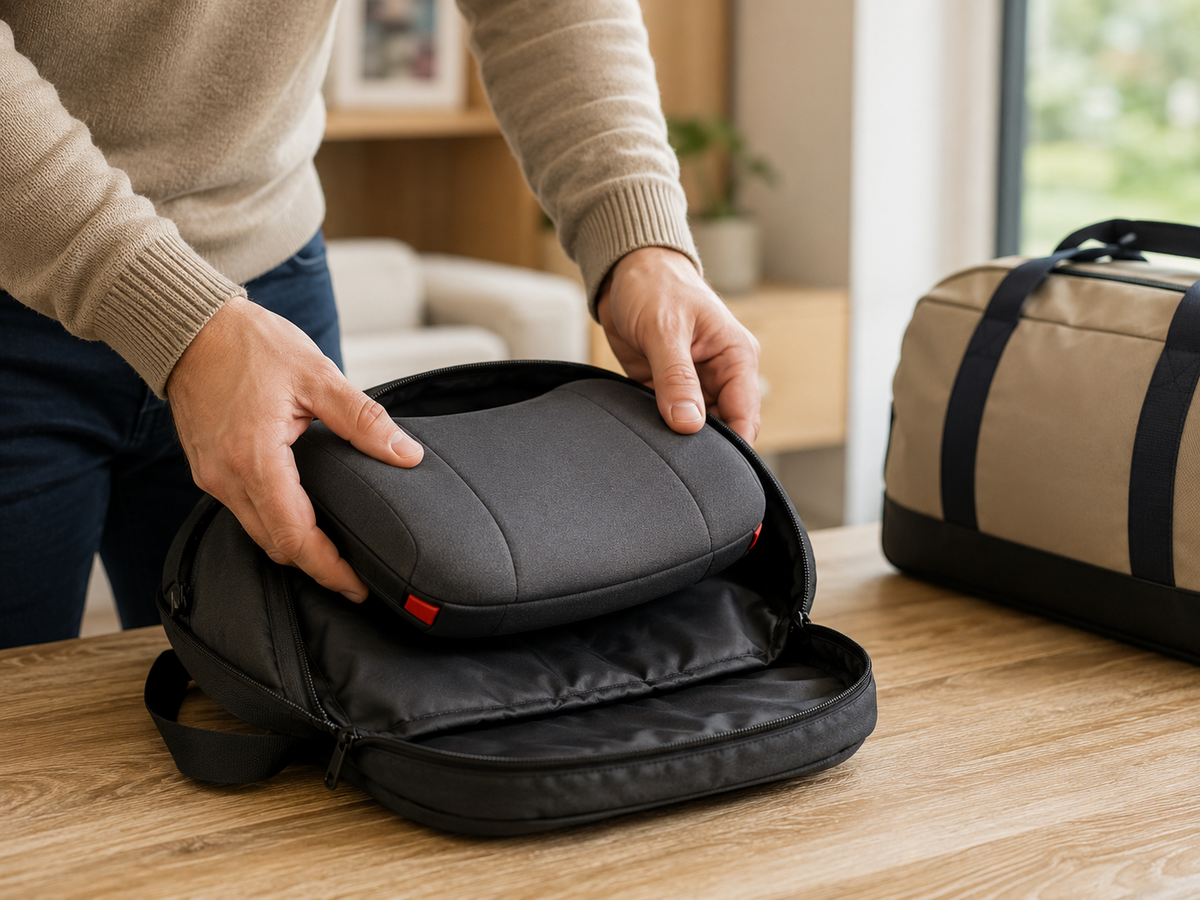
An unpackaged booster seat travels through the hold with zero protection – and neither the airline nor a rental company will pay for scratches, broken parts or stains.
So put the booster in a sturdy sack or a fabric bag with a drawstring. Fill any empty space with a blanket, diapers or cardboard padding – the seat mustn't shift around inside. Close the bag tightly and label it with your name, flight number and phone number.
If you still have the booster's original box, use it. Press it closed and tape it up on all sides with strong tape, stuffing any space inside with newspaper or clothing. Mark the outside "FRAGILE" and attach an identification label.
Before handing the booster over, take a short video or photos from every angle. If it's damaged in transit, you'll have proof of the condition it was in at handover – the foundation of every successful claim. By law you're entitled to flight delay compensation, and to compensation for damaged baggage too, but only if you have the evidence.
Wondering how to pack a stroller for a flight as well? The approach is similar – a sturdy cover, padding in the empty spaces, a label and photo documentation before handover.
Packing and transporting a child's car seat in the cargo hold
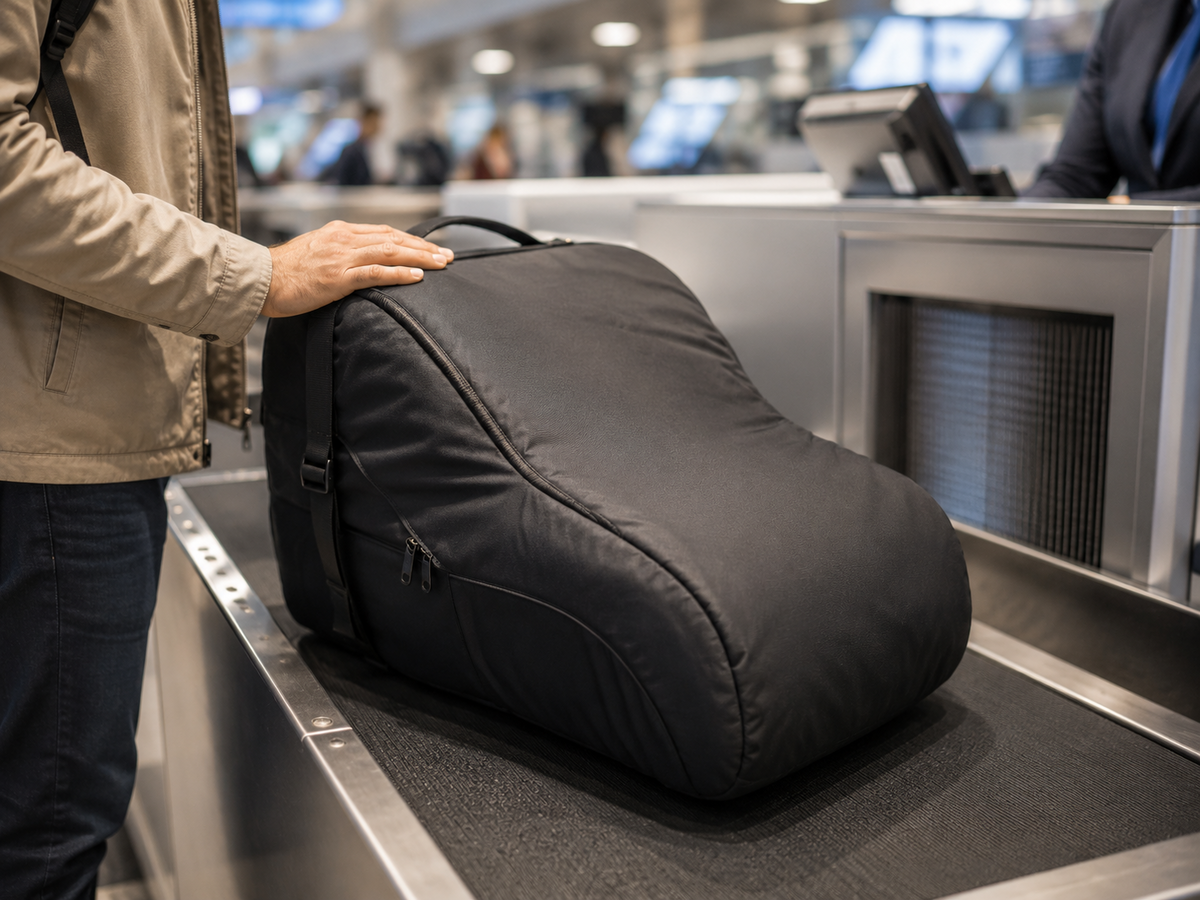
A full car seat needs more layers of protection than a booster. Here's a proven five-step routine:
- First, place the seat in a fabric bag or the manufacturer's dedicated travel bag.
- Pull a compression cover or compression sack over it to reduce the bulk.
- Put the wrapped seat into a cardboard box of matching size – ideally the original manufacturer's box or one of similar dimensions.
- Tape the box shut carefully with strong tape and fill any hollow spaces inside.
- Finally, add a carabiner or straps so it's easy to carry.
Travel bags made specifically for car seats sell online for 300–800 CZK. If you'd rather not buy one, some airports and car seat retailers will lend you one for a fee or even free of charge.
Choose direct flights with no connections, so the baggage is handled only once – every transfer is another chance for damage. Take out travel insurance with baggage cover and check that it applies to car seats; some insurers exclude them as sports or ancillary equipment.
Airline rules at a glance
| Airline | Car seat free | Booster free | Age limit | Certification on board |
|---|---|---|---|---|
| Ryanair | yes (baby item) | yes (baby item) | under 2 on lap free | TÜV / FAA, forward-facing, max. 43 cm |
| Wizz Air | yes (baby item) | unofficially yes | under 2 on lap for a fee | TÜV recommended |
| Smartwings | fee / by fare | per fare | under 2 on lap for a fee | TÜV recommended |
| easyJet | yes (baby item) | yes (baby item) | under 2 on lap for a fee | TÜV recommended |
| Lufthansa | yes | yes | under 2 on lap for a fee | mandatory on board |
Rules change, and every airline is free to amend them. Always verify the conditions directly on the carrier's website or by phone before buying your ticket.
The car seat is ready – now to sort out getting to the airport
All clear on the steps above? The last thing left is getting the whole family to the airport. With a child, a car seat and luggage, your own car is the most comfortable option – and guarded parking with a transfer straight to the terminal turns the whole departure into a stress-free affair.
Our comparison tool shows available parking at Prague Airport sorted by price, distance and reviews. Take a look at our overview of free parking at Prague Airport too, which covers the no-cost options along with their pitfalls. Have a great trip!
Flying with a child, a car seat and a stroller is a whole different game from traveling solo. Your own car plus guarded parking with a transfer straight to the departure hall makes everything dramatically easier. Use our comparison tool to find available spots at the airport, sorted by price and distance, with lightning-fast online booking.