Do you have a place sorted for your car before heading to the airport? With our comparison tool, you can easily compare all available guarded parking lots at the airport and reserve your spot in advance, stress-free.
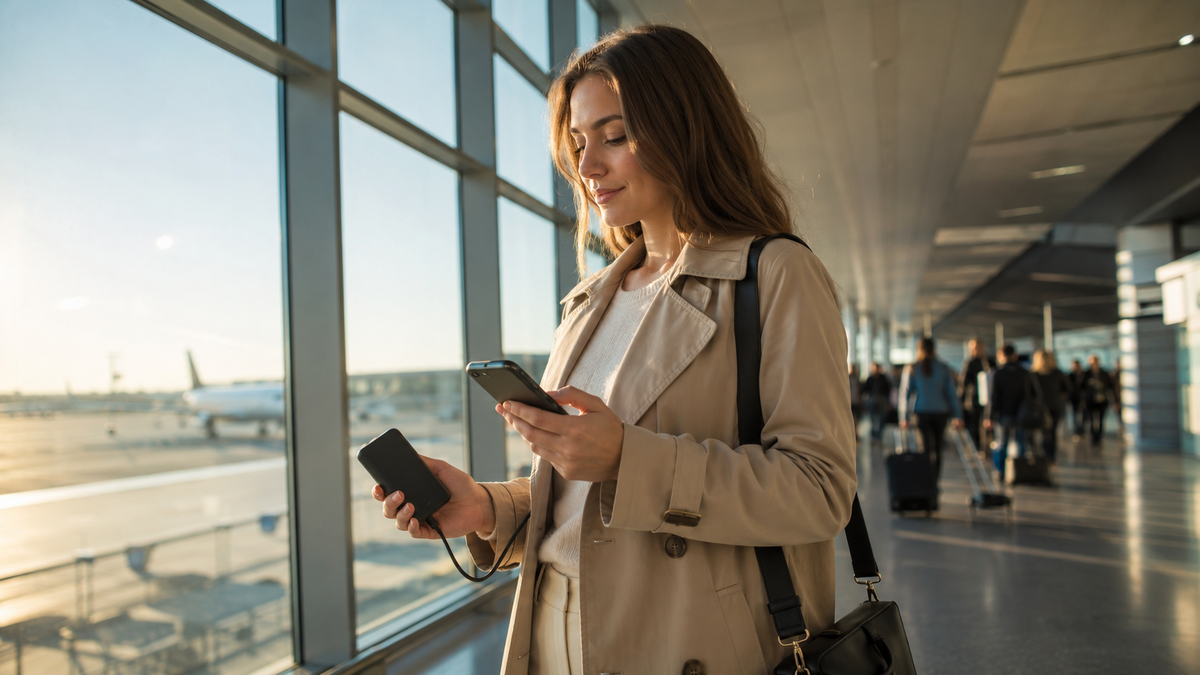
Can you bring a power bank on a plane?
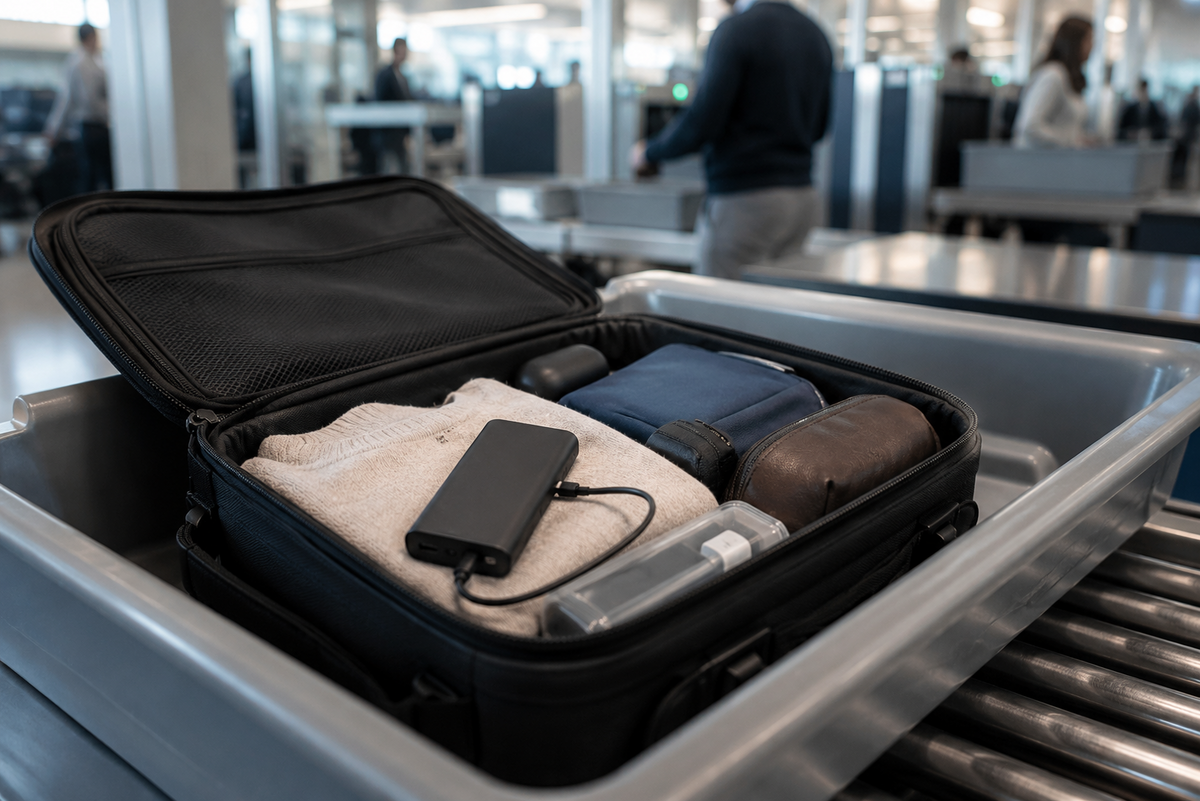
Yes, but with a catch that trips up everyone who packs one in a checked suitcase. Under international IATA rules, power banks are classified as spare lithium batteries and must always travel in your carry-on baggage in the cabin. They are never allowed in checked baggage in the hold – no exceptions.
The reason is fire safety. Under certain conditions, lithium batteries can spontaneously ignite. In carry-on baggage in the cabin, the crew can spot and extinguish a fire. In the sealed, inaccessible hold, that would not be possible in time. The X-ray at security will reliably detect a power bank in a checked suitcase – staff will then hold the bag back, delay the flight, or make you have the entire suitcase re-screened.
Every power bank must have its capacity clearly marked in mAh or Wh. Without this marking, security staff can refuse to let it through. UN38.3 certification (the international standard for safe transport of lithium batteries) is a plus that branded power banks usually come with as standard.
What power bank can you take on a plane
What matters is the Wh value, not mAh. Watt-hours account for both battery capacity and voltage and are the internationally recognized unit for transporting batteries by air. Manufacturers list capacity in mAh because the number looks bigger, but for airports, the Wh value is what counts.
The conversion is simple: Wh = (mAh × 3.7) / 1,000
Examples:
- 10,000 mAh ≈ 37 Wh
- 20,000 mAh ≈ 74 Wh
- 26,800 mAh ≈ 99 Wh
- 30,000 mAh ≈ 111 Wh
If your power bank doesn't show the Wh value directly on the casing, do the conversion from mAh yourself and write the result on a sticker. At screening, you'll have the number right at hand.
Just as with medicines on a plane, clear labeling and documentation significantly speed up your passage through security.
Booking airport parking online well ahead of your flight means one less worry on departure day. With our comparison tool, you see current availability, prices, and reviews all in one place. Choose, click, and your spot is guaranteed.
Power bank on a plane – capacity and limits
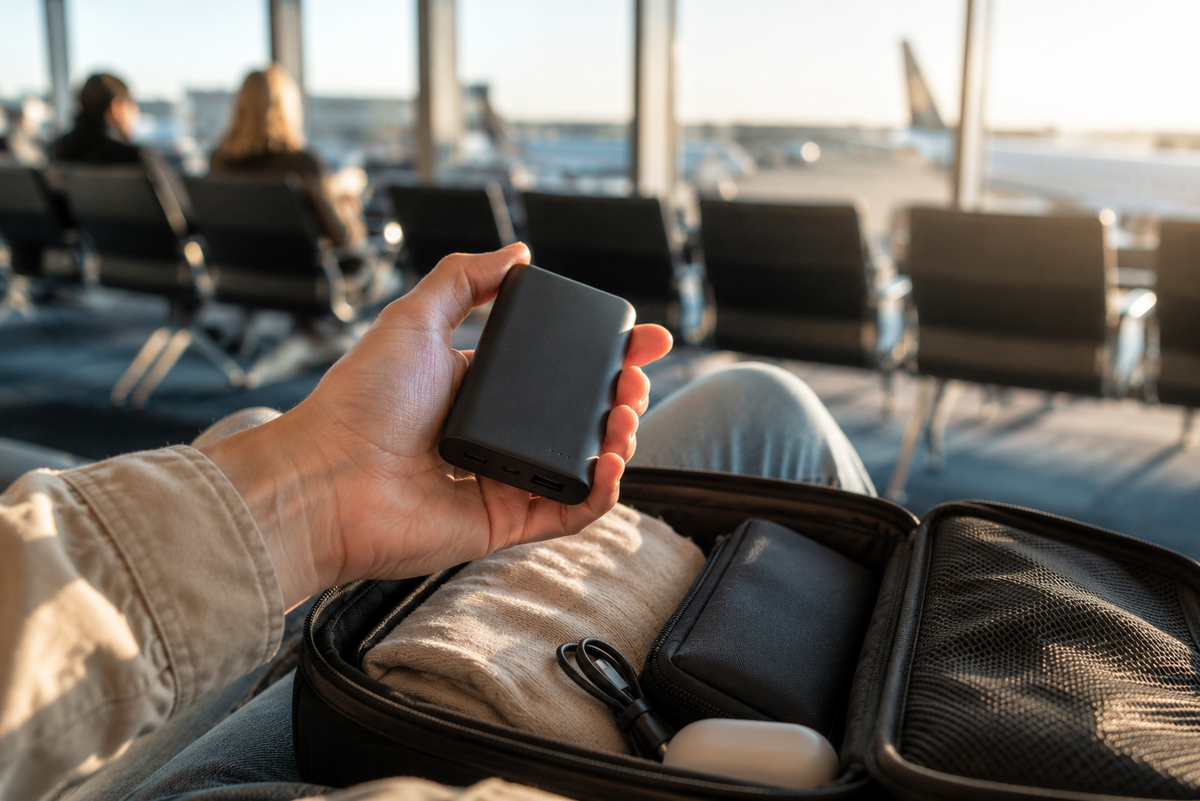
The IATA rules for 2026 set three tiers:
- Up to 100 Wh – allowed without any special approval. You may carry several units for personal use; your airline may specify the exact number, but 1–3 units typically go through without issues.
- 100–160 Wh – allowed only with the airline's approval, usually a maximum of 2 units per person. Contact your carrier before departure and get the approval confirmed in writing.
- Over 160 Wh – always forbidden, everywhere, no exceptions.
The practical limit for hassle-free passage without any special arrangement is 99 Wh (roughly 26,800 mAh). Power banks over 100 Wh can technically be carried, but they require prior approval, and not every airline grants it willingly.
Rules for selected airlines
| Airline | Limit without approval | With approval | Use in flight |
|---|---|---|---|
| Ryanair | up to 100 Wh | 100–160 Wh, max. 2 units | allowed |
| Wizz Air | up to 100 Wh | 100–160 Wh, max. 2 units | allowed |
| easyJet | up to 100 Wh | 100–160 Wh, max. 2 units | allowed |
| Smartwings | up to 100 Wh | 100–160 Wh, max. 2 units | allowed |
| Lufthansa | up to 100 Wh | 100–160 Wh, max. 2 units | forbidden in flight |
| Emirates | up to 100 Wh | 100–160 Wh, max. 2 units | forbidden in flight |
| Air France | up to 100 Wh | 100–160 Wh, max. 2 units | forbidden in flight |
| Etihad | up to 100 Wh | 100–160 Wh, max. 2 units | forbidden in flight |
Heads up: Emirates, Air France, Etihad, and Lufthansa forbid using power banks during the flight. You can keep one in your carry-on, but you cannot charge devices from it. Some airlines also require your power bank to stay in the seat pocket in front of you during the flight, not in the overhead bin.
If you're connecting through another airport, the stricter rules of the transit country may apply. For flights to the USA or via Dubai, always check the conditions in advance.
You'll find a full rundown of carry-on baggage dimensions for individual airlines in a separate guide – your power bank will take up its share of space in your carry-on, so it's good to know how much room is left for everything else.
Guarded parking with a direct transfer to the terminal, a fenced site, and 24/7 cameras – all things you can select and book through our comparison tool from home. On departure day, focus on your trip, not on hunting for a parking spot.
How to pack and use a power bank on a plane
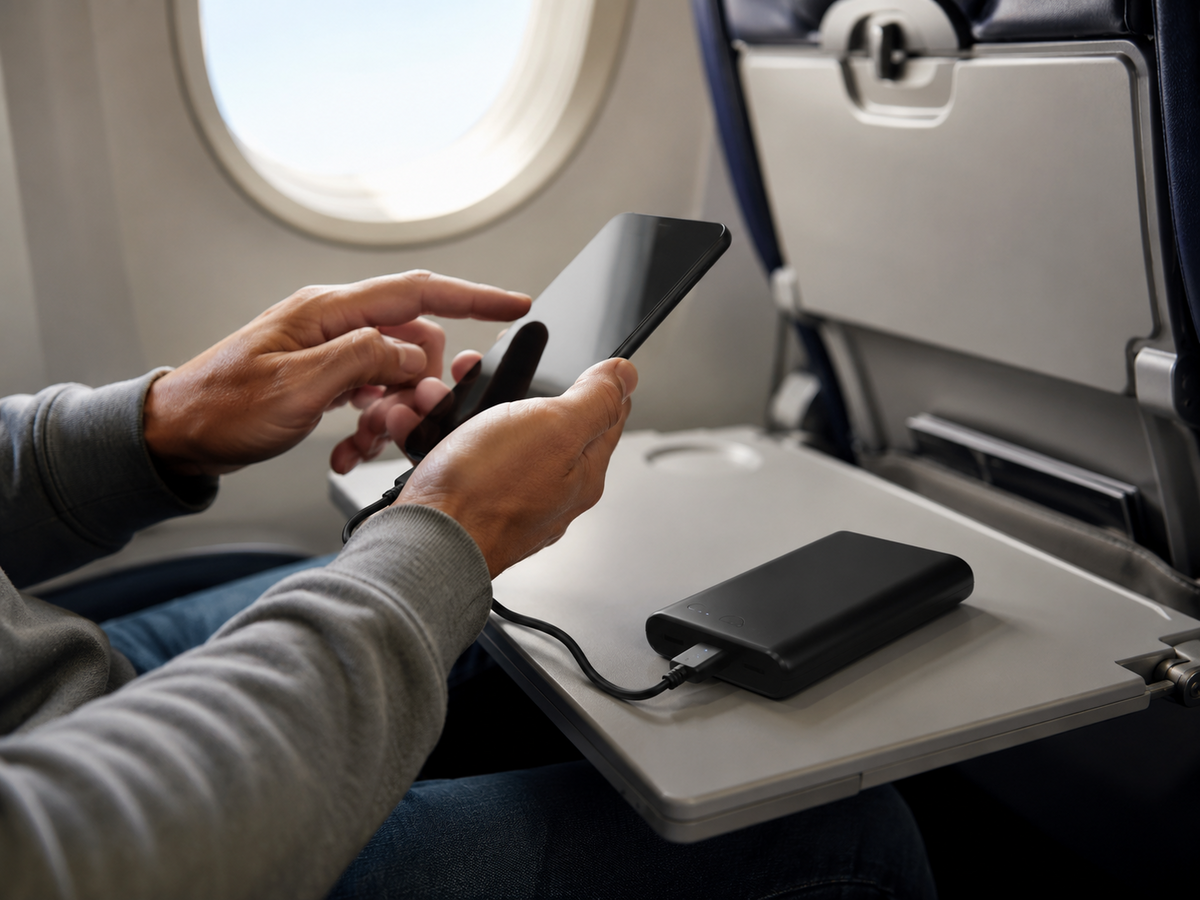
- Your power bank travels in your carry-on and must be easy to reach. Security staff may want to see it during screening. Don't bury it at the very bottom of your backpack under layers of clothing.
- Protect the connectors from short circuits. A clear plastic bag or a small case is the easiest way. A covered plug can't accidentally touch metal objects in your bag. Also prevent it switching on by accident – if your power bank has a physical button, secure it so it can't be pressed unintentionally.
- The recommended charge level is 30–70%. A fully charged or completely drained lithium battery is more prone to problems in extreme conditions; a mid-level charge is gentler on the battery and more practical.
- Keep your power bank within reach during the flight, too. If it starts overheating or shows other warning signs, you must hand it to the crew immediately. A power bank in the overhead bin is out of your control.
- Pack the charging cable as well. Many aircraft, especially on longer routes, offer USB ports or power outlets right at your seat. Combining an in-flight outlet with a power bank as backup is ideal for longer trips.
Best power bank for a plane – how to choose
For most travelers, a capacity of 10,000 to 20,000 mAh (37 to 74 Wh) is ideal. It will recharge your phone two to three times, fits in any bag, and passes screening without questions.
If you want maximum capacity without needing approval, go for a 26,800 mAh model, roughly 99 Wh. That's the practical ceiling below the 100 Wh limit.
When choosing, look at the output in watts, not just the capacity. 20–30 W is enough for phones, 30–45 W for tablets, and 45–65 W for ultrabooks. USB-C with Power Delivery is standard these days and ensures fast charging across your devices.
A compact body and low weight matter most if you're traveling with carry-on only and every gram counts. An LED charge indicator, pass-through charging, or built-in cables are nice bonuses, but not essential.
Now you know the power bank rules – time to think about everything else
Before you fly, also check how early you should be at the airport so you have plenty of time for security screening and any questions about your power bank. As for parking, everything about how booking works – from choosing a lot to arriving – is covered on the page how airport parking booking works. The guide applies to most airport parking lots worldwide, including parking at Prague Airport. Have a great flight!
One site, thousands of parking lots, up-to-date prices. Our comparison tool finds available guarded parking spots at any airport worldwide for you – just enter your dates and pick by price, distance, or rating. Your reservation can be sorted in two minutes.