There's enough stress around flying already — why add parking stress on top? Reserve the right parking spot with our comparison tool in a matter of minutes and drive to the airport with peace of mind.
What Liquids You Can Take on a Plane
The 100 ml rule covers a far wider range of items than most travelers realize. At security, anything that can flow, be applied, or be sprayed counts as a liquid.
In practice, that means drinks of all kinds, soups, yogurts and jams, creams and facial toners, shampoos and shower gels, toothpaste, mascara and liquid eyeliner, spray or roll-on deodorants, powdered milk mixed with liquid, sunscreen and much more.
What doesn't count as a liquid: bar soap, shampoo bars, stick deodorant, lip balm and solid body butter. These products are exempt from the 100 ml rule and can travel in your carry-on without restrictions.
The rules for checked baggage are different — you can pack liquids in any quantity and any container size into the suitcase that goes in the hold.
How Much Liquid Is Allowed on a Plane
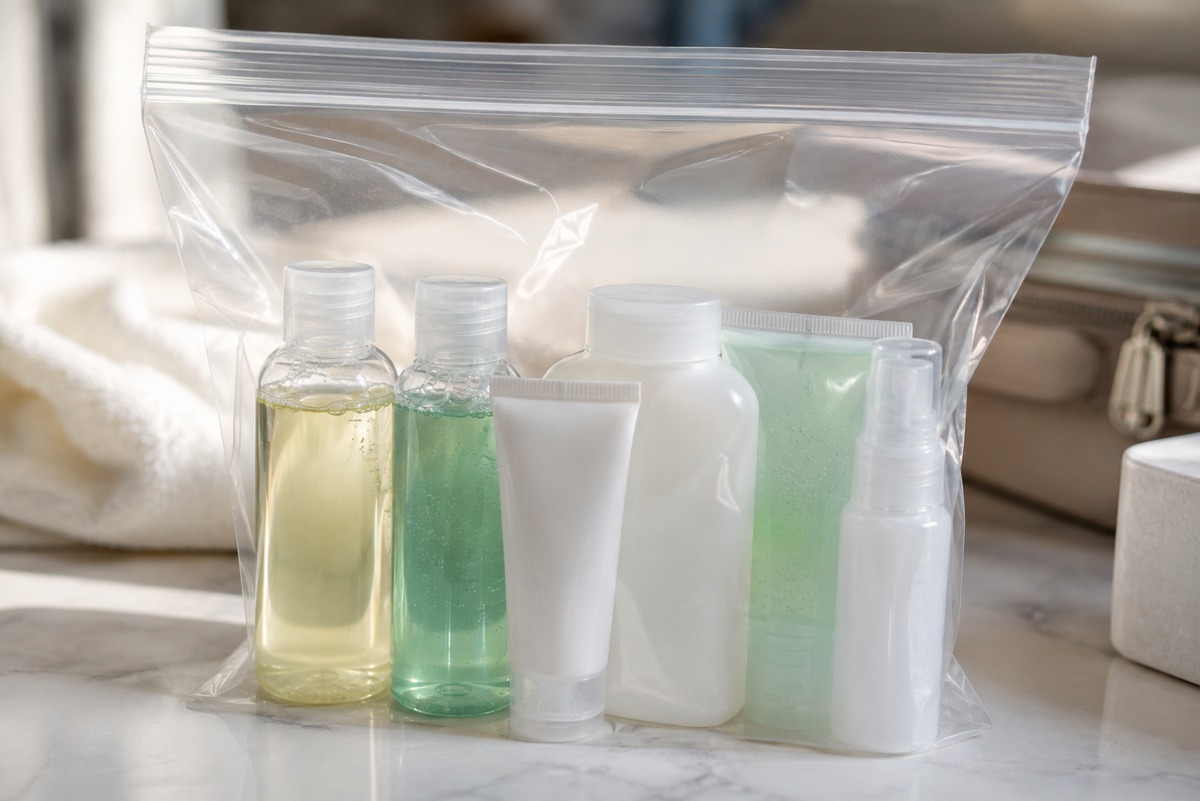
The standard rule is that each container of liquid may hold a maximum of 100 ml. All liquids must fit into a single transparent resealable bag with a total capacity of roughly 1 liter, and each passenger is allowed one such bag.
Watch out for half-empty containers too — what counts is the volume printed on the packaging, not how much is actually left inside. A bottle labeled 200 ml with only 50 ml in it will not get through. Decant your products into small travel bottles marked with the correct volume.
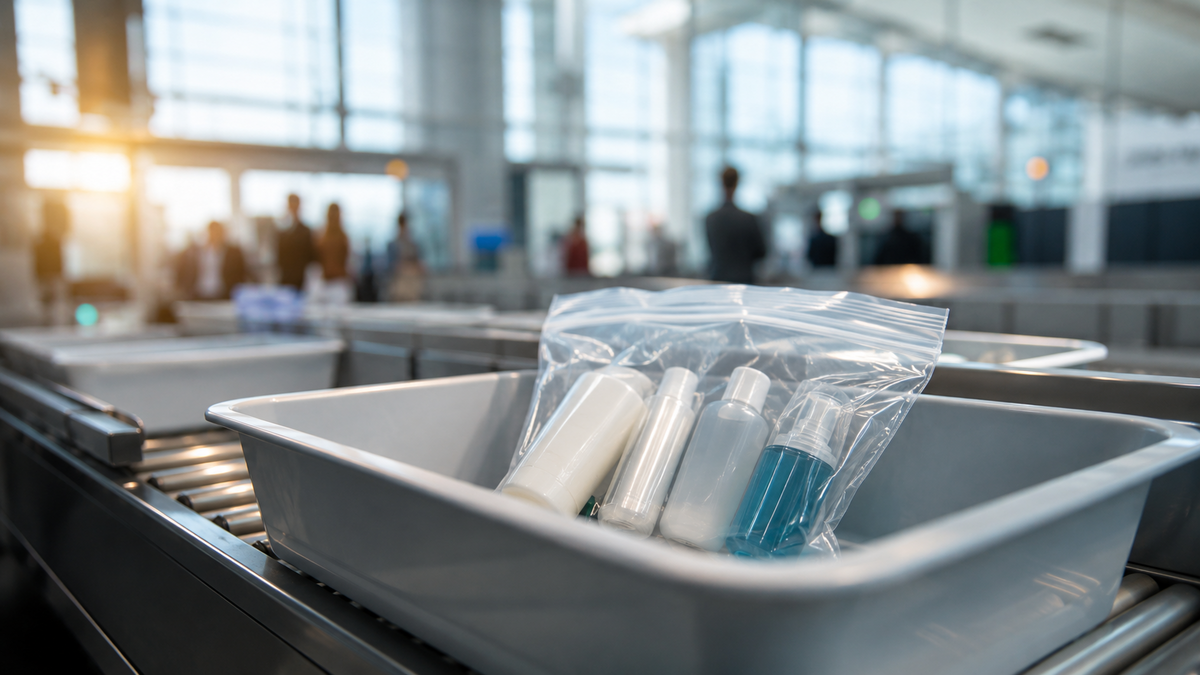
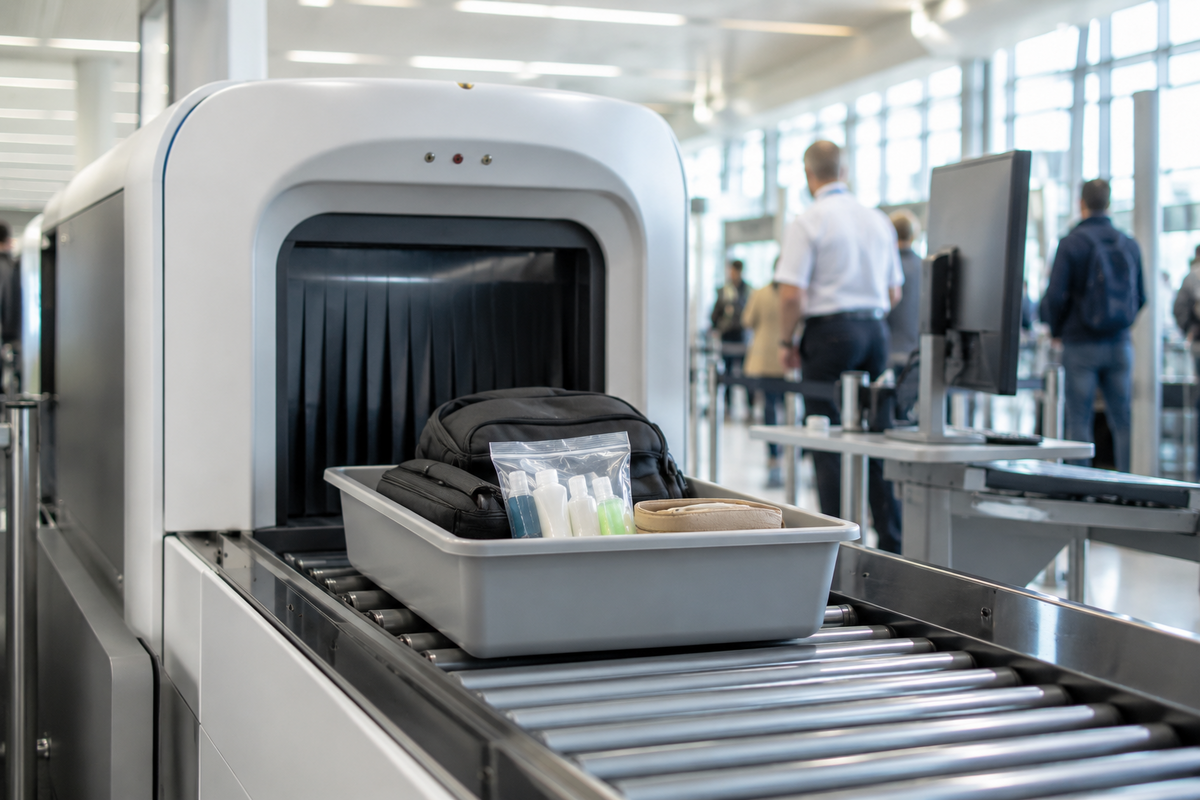
You need to take the liquids bag out of your carry-on before you enter the screening line and place it in a tray on its own. Skip this step and you'll hold up the whole queue, making screening take longer for yourself and everyone else.
For a more detailed rundown of what is and isn't allowed in your hand luggage, see our article on carry-on baggage dimensions.
You hand over your suitcase at the check-in counter and won't see it again until the carousel at your destination. Anything you can't do without on board needs to be in your carry-on — including your bag of liquids.
Cheapest, closest, or best rated? Our comparison tool shows every parking option near any airport in the world. Reserve your spot in advance, knowing your car will be well looked after.
How to Pack Liquids for the Plane
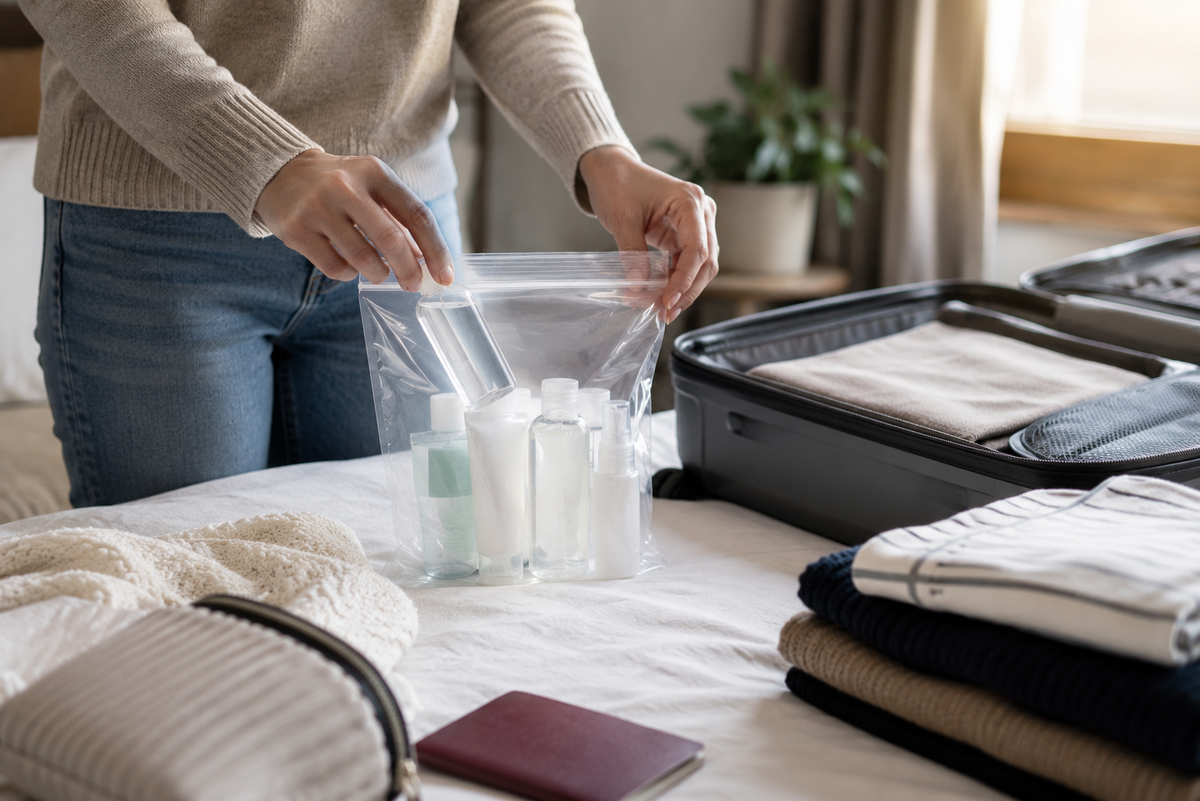
A transparent resealable bag (ziplock) is the foundation. A standard 20 × 20 cm or 18 × 20 cm size holds roughly 6–8 small bottles. The bag must be easy to open and close, as security staff may ask you to open it during the check.
Pack your liquids into the bag calmly at home, not at the last minute at the airport. Put the bag at the top of your carry-on or backpack, or in an outside pocket where you can pull it out quickly.
Here's a practical tip every seasoned traveler will appreciate: take an empty plastic bottle with you. It goes through security without any problem, and once you're through, you can refill it for free in the duty-free zone. You'll have plenty to drink on board without paying over the odds for drinks at the gate.
Liquid medications over 100 ml are exempt but require a doctor's certificate. Read the detailed rules in our article on medications on a plane.
Exceptions to the Liquid Limit on a Plane
The 100 ml rule doesn't apply to several specific categories — but you must always declare them to the security staff:
- Baby food and infant formula are allowed on board in quantities appropriate to the length of the flight, regardless of volume. You just need to be traveling with the child; documents are usually not required, though this depends on the airport.
- Special dietary products needed for medical reasons — such as liquid nutrition for post-surgery patients or diets prescribed by a doctor — are permitted with the appropriate documentation.
- Medications essential to the passenger's health get through even above 100 ml, but always with a prescription or doctor's certificate in English or the language of the destination country. Insulin, inhalers or special drops can be carried in whatever quantity you need.
- Drinks bought in the duty-free zone after security are not subject to the limit at departure. Watch out with connections, though — at a transfer airport, duty-free purchases go through screening again, and without a sealed security bag (STEB) they're only allowed in the cabin up to 100 ml.
Liquids on a Plane in 2026 – What Changed at Prague Airport
Václav Havel Airport Prague introduced a major change to its liquid rules on October 1, 2025 — but it applies only to Terminal 2.
The terminal has been fitted with new CT X-ray scanners that can analyze the contents of your bags in far more detail without you having to take anything out. The standard bag of liquids up to 100 ml is still required, but each passenger can now also bring one container of up to 2 liters — a bottle of water, another drink, or sunscreen in a larger size, for example. And when passing through these scanners, you no longer need to take out your electronics or your liquids bag.
This change applies exclusively to Terminal 2, however, which handles flights within the Schengen area (Germany, France, Italy, Spain, Greece and others). Terminal 1, which handles non-Schengen flights, remains unchanged — the standard rule of 100 ml in a one-liter bag still applies there.
Be aware that the fast track (priority lane) at Terminal 2 may use an older scanner without CT technology, where the old rules still apply. A return flight from any airport other than Prague also follows that airport's rules — the change doesn't extend there. Similar technology has, however, been running at both terminals of Munich Airport since September 2025.
For a step-by-step look at what awaits you at the checkpoint, see our article on airport security screening.
Why Can't You Take Unlimited Liquids on a Plane – and Will That Ever Change?
The 100 ml rule was born in 2006 as a direct response to a terrorist plot uncovered in the United Kingdom. British intelligence foiled an attack in which liquid explosives made from commonly available chemicals were to be mixed on board aircraft. The attackers carried the ingredients in separate bottles — and on their own, the components looked completely harmless.
The International Civil Aviation Organization (ICAO) then introduced the 100 ml limit as a compromise between security and practical travel. Containers of this size are transparent enough under X-ray to detect dangerous substances, and in such small volumes, liquid explosives can only be mixed in amounts too small for an effective explosion.
The new CT scanners gradually replacing conventional X-ray machines at European airports, however, can now analyze the chemical composition of liquids without a physical check. That's exactly why the limits can be relaxed wherever they are installed.
Prepare Your Liquids at Home – Just Like Your Parking
The 100 ml rule in a one-liter bag still applies at the vast majority of airports worldwide. At Prague's Terminal 2 you can now add one container of up to 2 liters — but only if you're not going through a fast track lane with an older scanner. At Terminal 1 and at foreign airports, nothing changes.
The most reliable strategy remains the same: an empty bottle in your bag, the pouch of mini bottles on top, and medications with a doctor's certificate. Screening will go smoothly, and free drinking water will be waiting for you past security.
Sorting out parking before your trip is a bigger task, and we recommend tackling it early. Exactly how a reservation works is explained on our page about how airport parking reservations work. And for a rundown of the specific advantages of secure parking over street parking or the Prague 6 zone, see our page on the benefits of airport parking.
Pick your parking through our comparison tool before departure, confirm your reservation, and set off for the airport one worry lighter. You pay on arrival, and cancellation is free up to 24 hours in advance.